


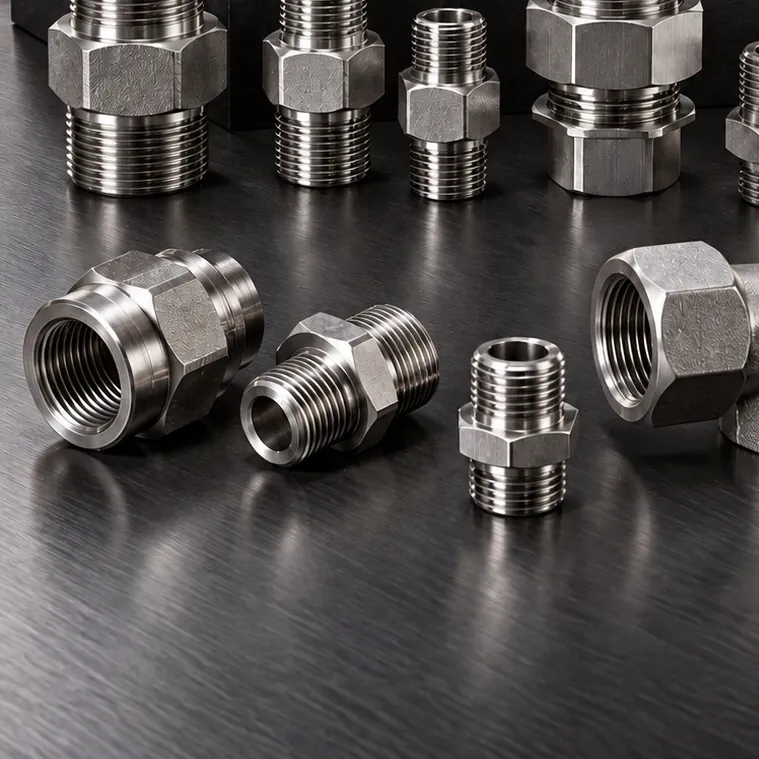
DIN 2353 Compression Fittings
Male Stud Connector (BSPP)
Stainless steel male stud connector with a 24° cone tube end and BSPP male thread, connecting tube to pump, valve block or…
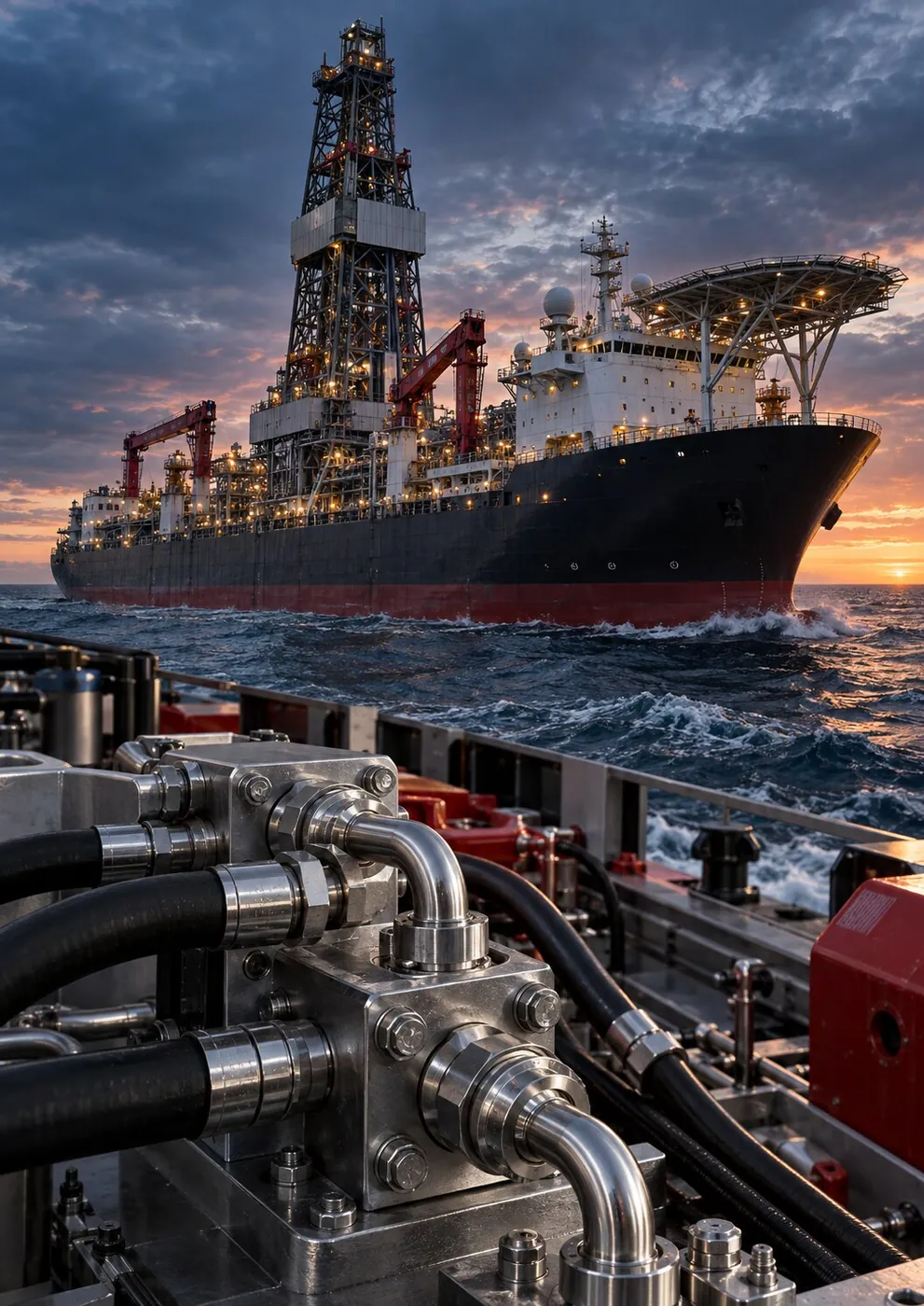
Drillships · Power units · Salt exposure
AISI 316L hose ends, SAE flanges, adapters and valves for crane, pipe handling, deck machinery and power unit lines on drillships and platforms.
Featured products in this sector
View all 23 productsProducts
23 products are listed for the operating conditions of Offshore & Drilling. Narrow down by group; open a product page for sizes and thread standards.
DIN 2353 Compression Fittings
Stainless steel male stud connector with a 24° cone tube end and BSPP male thread, connecting tube to pump, valve block or…
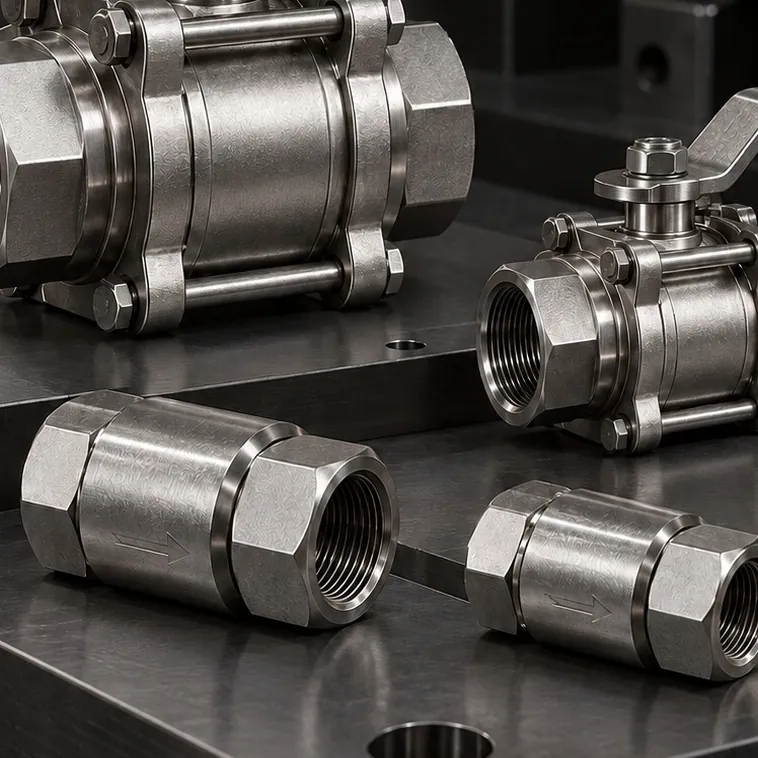
Ball, Needle & Check Valves
High-pressure stainless steel ball valve with an AISI 316L body, providing quarter-turn on/off service in hydraulic and process…
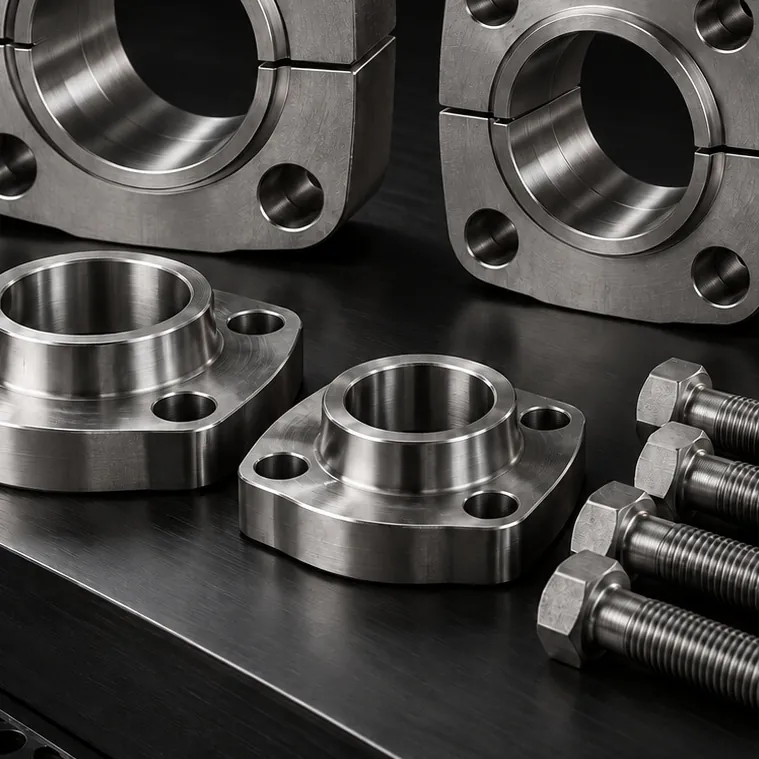
SAE Flanges (Code 61 / 62)
Two-piece stainless steel split flange clamp that holds a flanged-head hose fitting or tube end against an SAE Code 61 port…
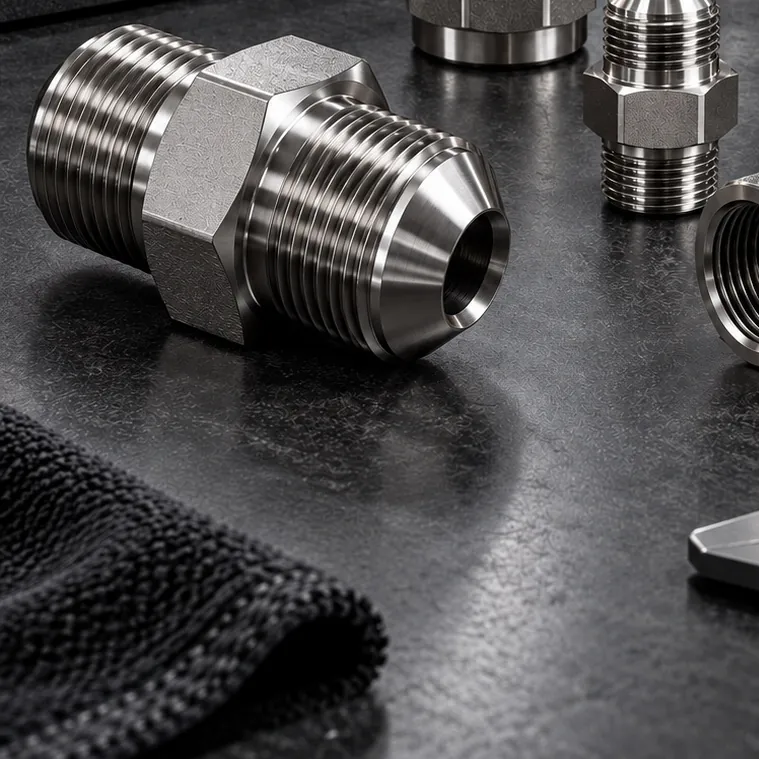
JIC 37° Fittings & Adapters
Stainless steel straight adapter with UNF male threads and JIC 37° cone seats at both ends. Joins two female swivel hose or tube…
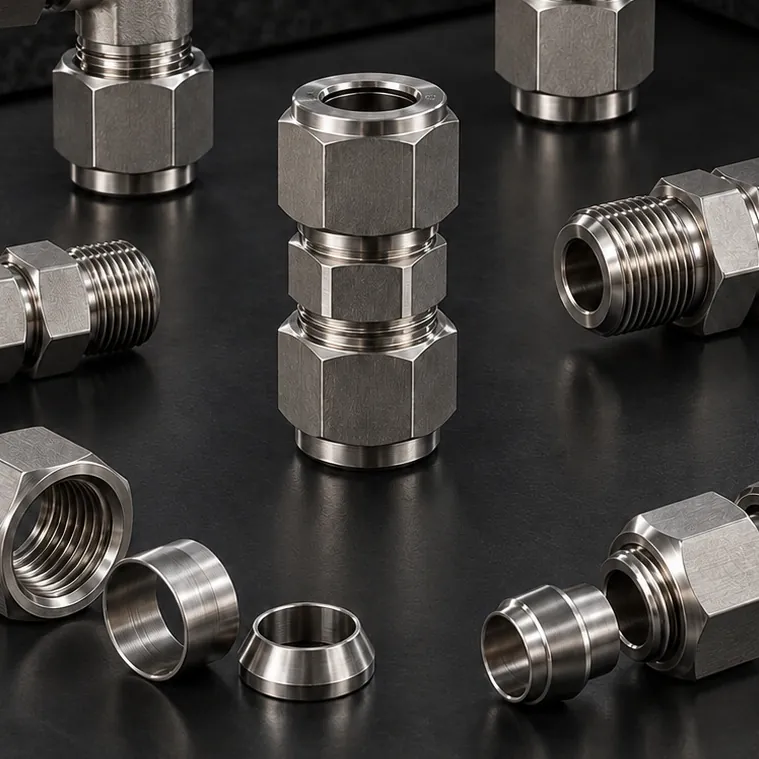
Twin Ferrule Instrumentation Fittings
Stainless steel twin-ferrule union joining two instrumentation tubes on the same axis. Weld-free, repeatable makeup in…
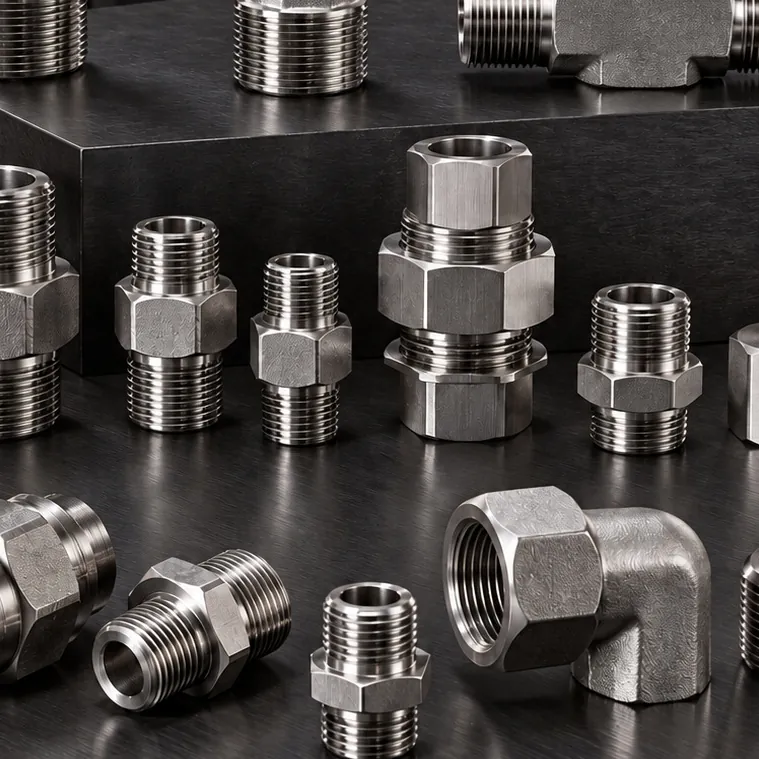
DIN 2353 Compression Fittings
24° cone straight coupling (DIN 2353) that joins two stainless steel tubes on the same axis without welding. AISI 316L body, L…
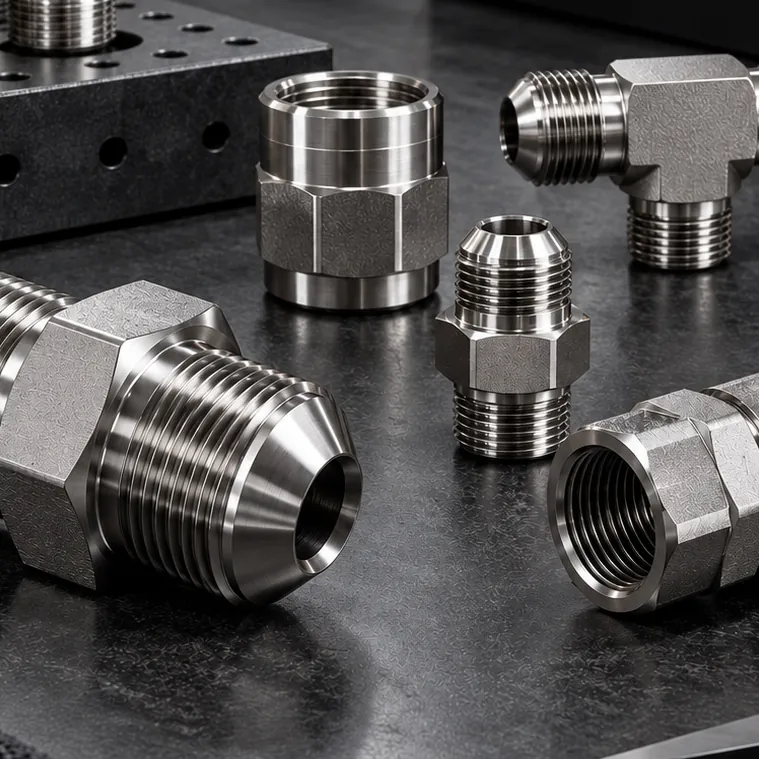
DIN 2353 Compression Fittings
Stainless steel 24° cone bulkhead coupling with locknut that routes a tube line through a panel, tank wall or ship bulkhead in a…
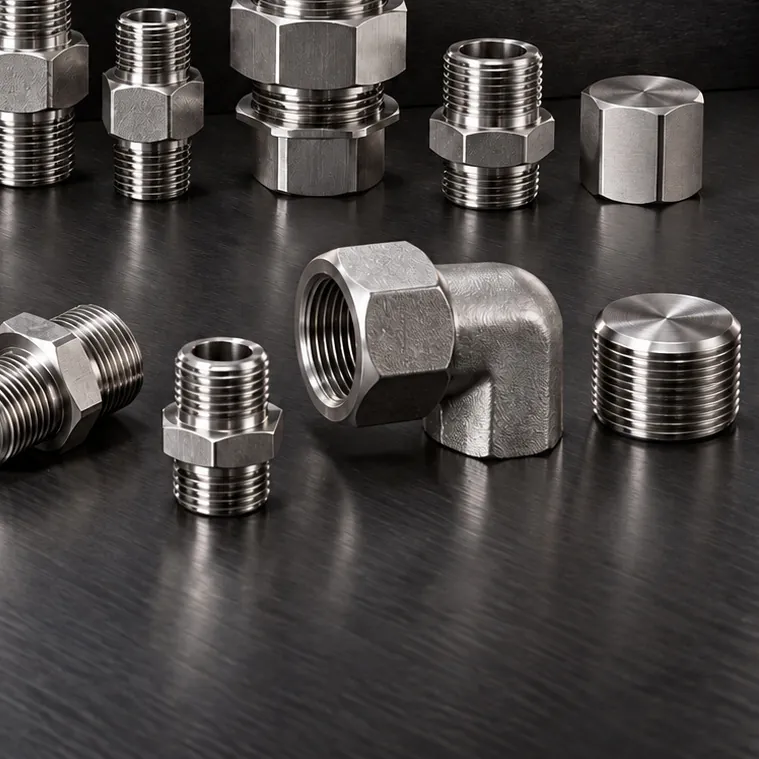
DIN 2353 Compression Fittings
Stainless steel 90° male stud elbow with a 24° cone tube connection on one end and a male NPT thread on the other. Tube outlet…
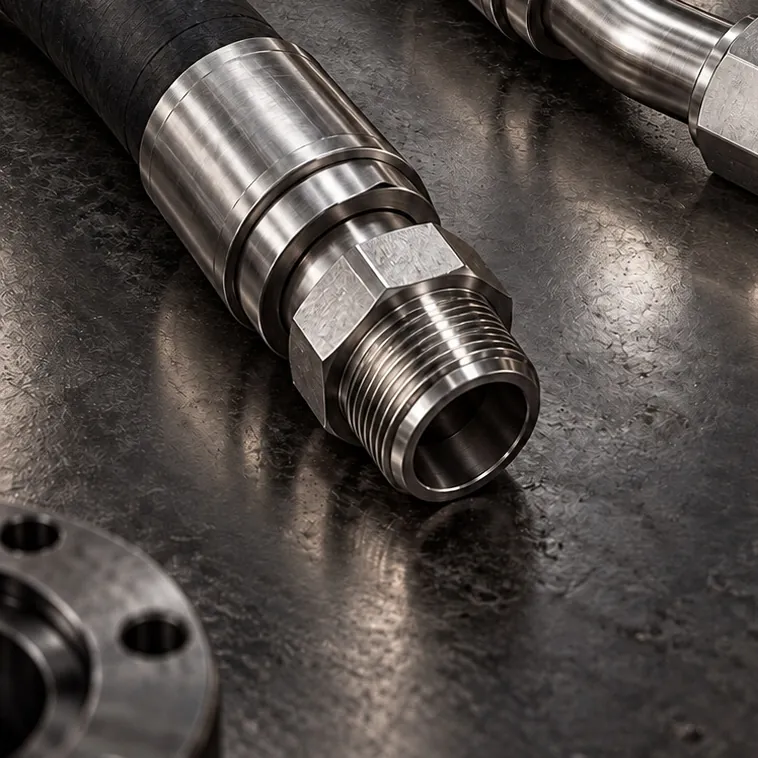
Hose Fittings & Ferrules
Stainless steel straight hose fitting with a female UNF swivel nut and JIC 37° cone seat. Crimp hose end for hydraulic systems…
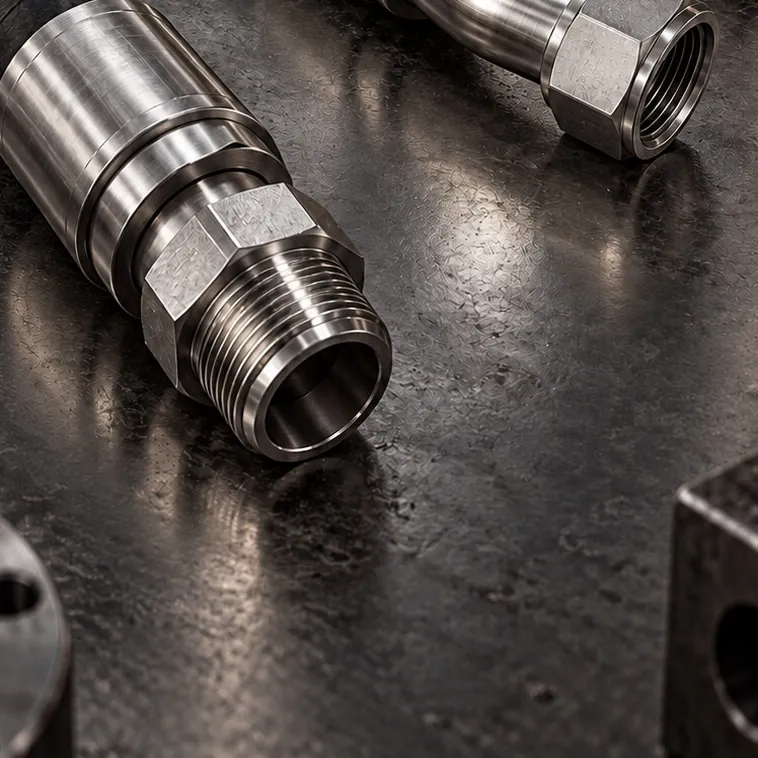
Hose Fittings & Ferrules
Stainless steel O-ring face seal (ORFS) hose fitting with a female swivel nut. Reduces the risk of leaks in high-pressure lines…
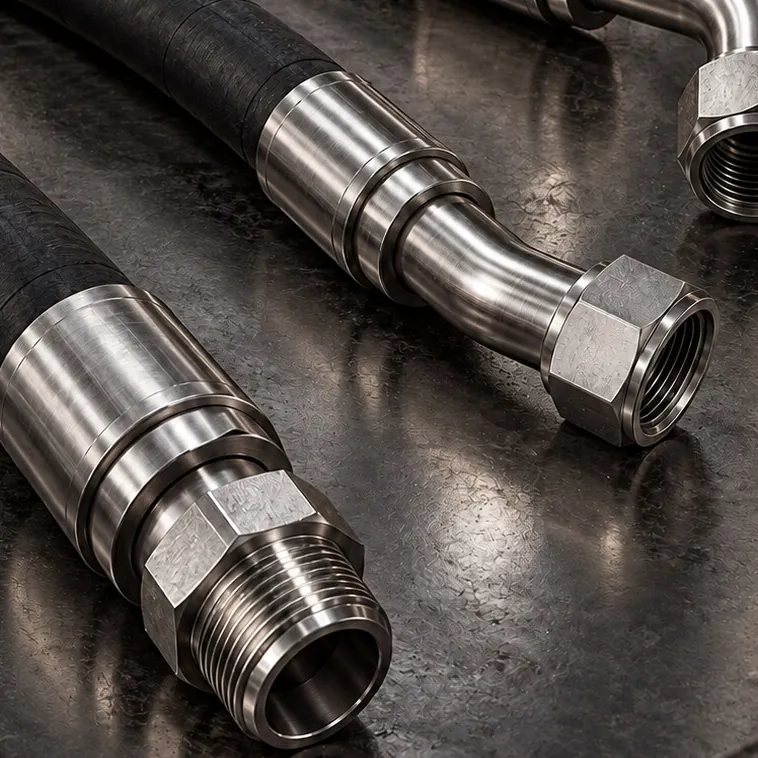
Hose Fittings & Ferrules
Stainless steel crimp-style 90° hose fitting with an SAE Code 61 flange head. Connects to pump and block ports in large-bore…
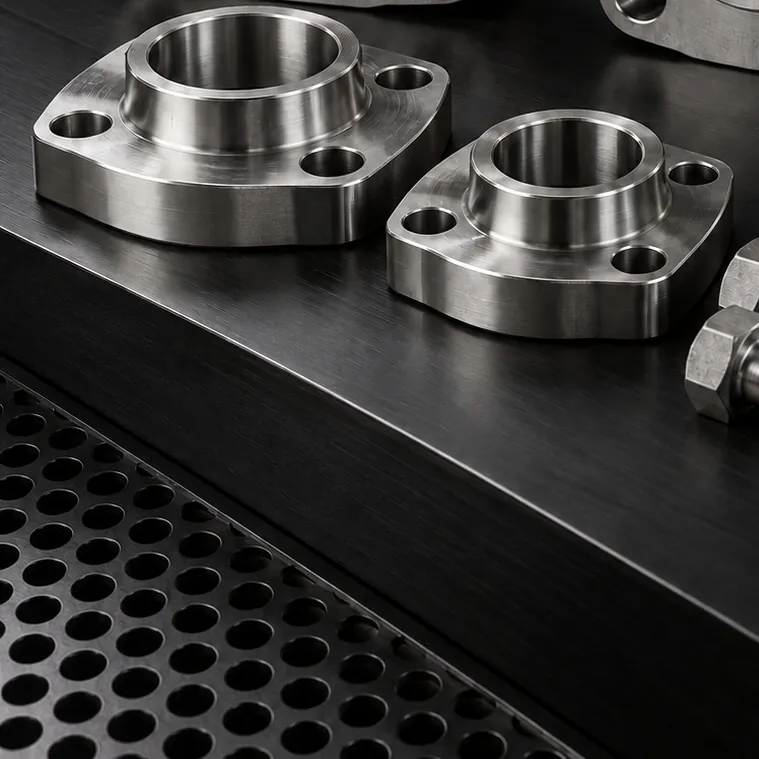
SAE Flanges (Code 61 / 62)
Stainless steel SAE Code 62 mating flange for high-pressure hydraulic lines. Connects the pipe to a Code 62 port via a welded or…
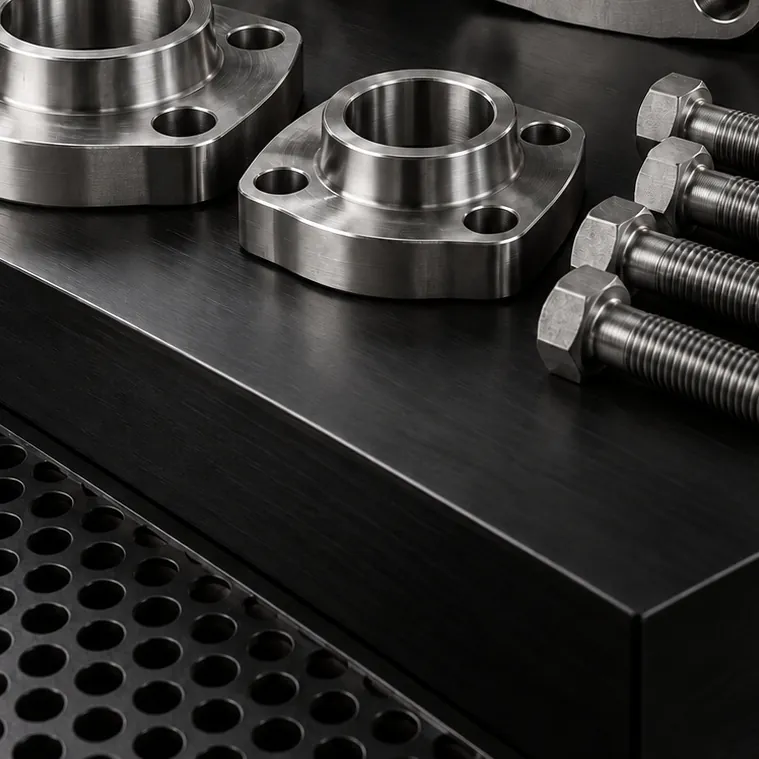
SAE Flanges (Code 61 / 62)
Stainless steel blind flange for closing off unused SAE flange ports or flanged line ends. Made to Code 61 and Code 62 port…
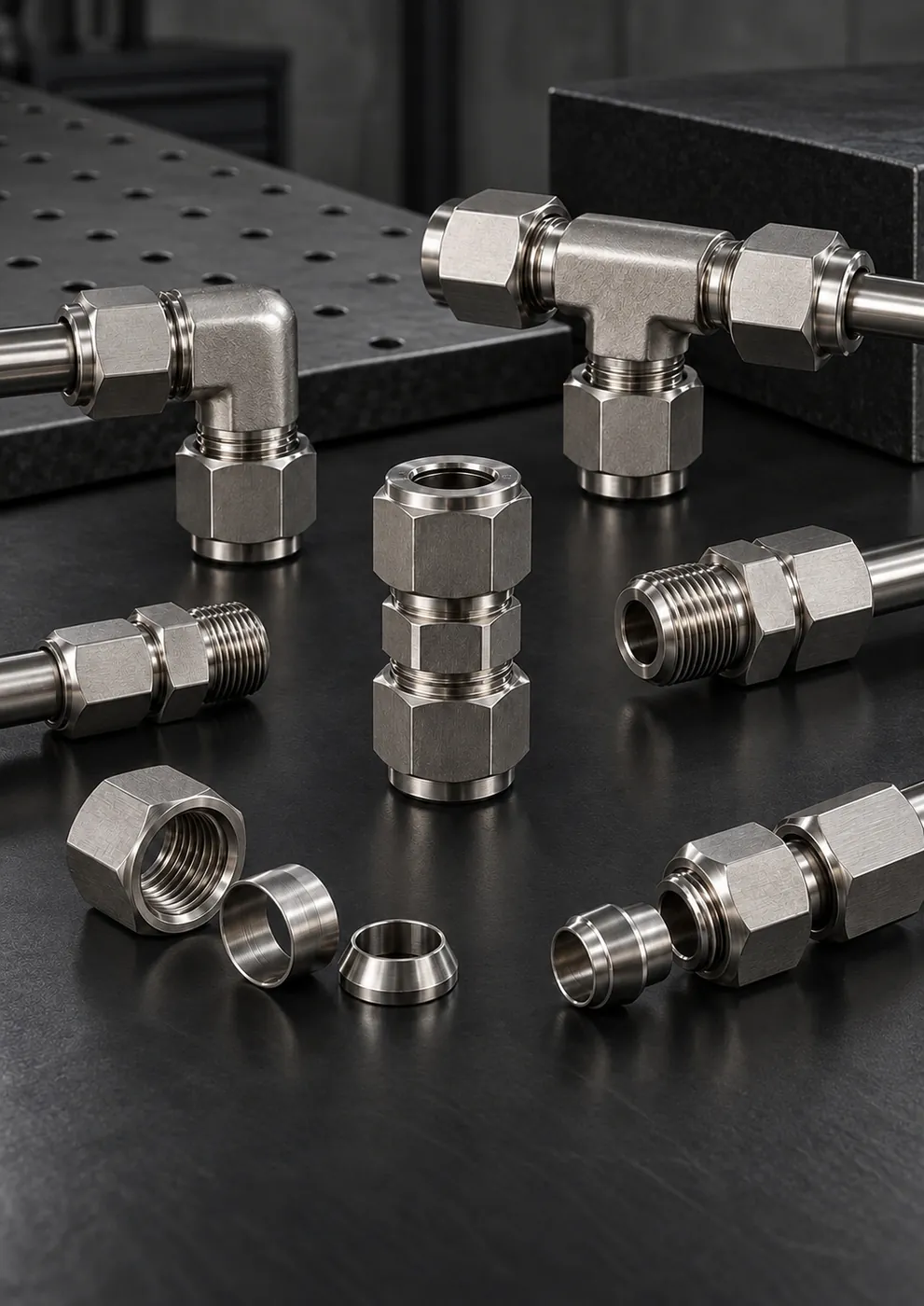
Twin Ferrule Instrumentation Fittings
Stainless steel twin ferrule union elbow joining two instrumentation tubes at 90°. Change of direction without bending tube…
Twin Ferrule Instrumentation Fittings
Stainless steel union tee with three twin ferrule ends for branching measurement and control lines. For transmitter, pressure…
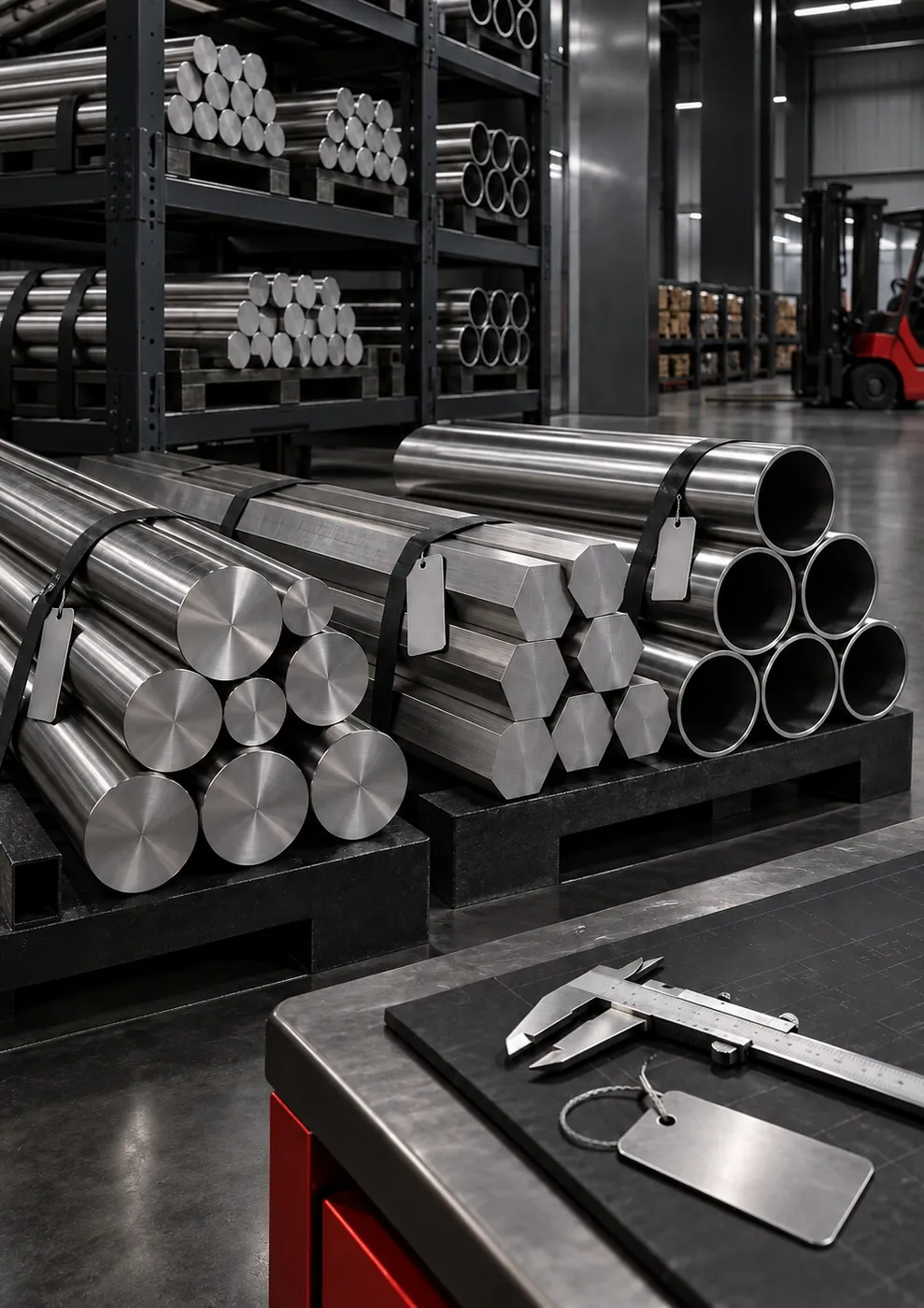
Stainless Steel Pipes & Flanges
Seamless stainless steel hydraulic tube in metric OD sizes for bite-type compression fittings and welded lines. AISI 316L; wall…
JIC 37° Fittings & Adapters
Straight stainless steel adapter with a JIC 37° UNF male end and an NPT tapered male thread. Connects JIC hoses or tubing to…
JIC 37° Fittings & Adapters
Straight stainless steel ORB to JIC adapter with an SAE O-ring boss (UNF) port end and a JIC 37° male line end. Secure port…
BSP / NPT Adapters & Nipples
Stainless steel conversion adapter with a BSP male thread on one end and an NPT male thread on the other. Connects equipment…
BSP / NPT Adapters & Nipples
Hex-body stainless steel reducing bushing with a male NPT tapered thread outside and a female NPT tapered thread inside. Steps…
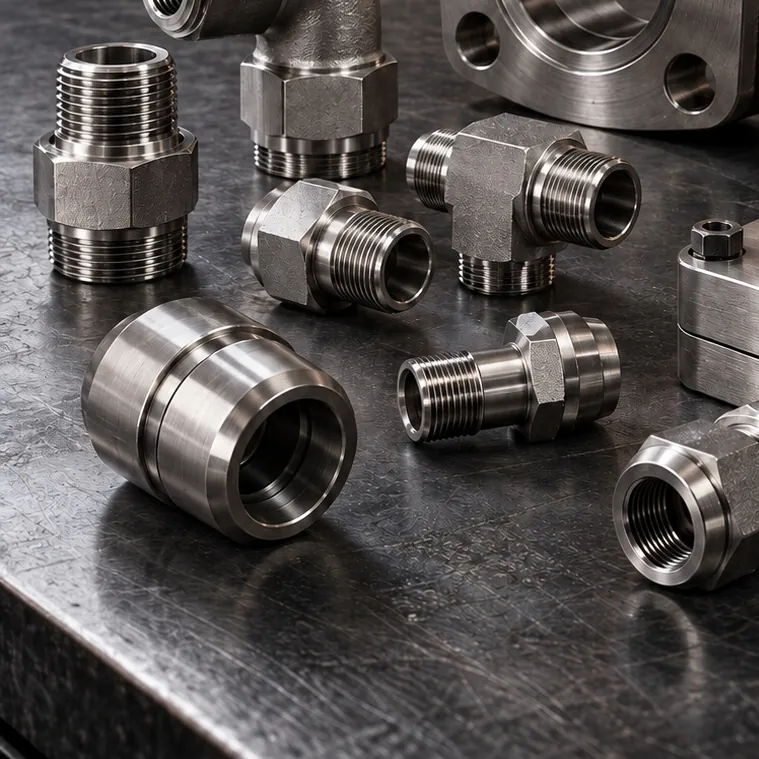
Weld Nipples & Weld Fittings
Stainless steel set consisting of a 24° cone body, a nut and an O-ring weld nipple that is butt-welded to the tube. Adds a…
Weld Nipples & Weld Fittings
Stainless steel bulkhead coupling welded into a ship bulkhead, tank wall or shell plate, with 24° cone compression connections on…
Quick Disconnect Couplings
Stainless steel-bodied male-female quick disconnect coupling with BSP threads. Fast, tool-free connection at test points, on…
Can't find your part in the list?
Send a sample photo, technical drawing or dimensions; we'll identify the right fitting from our catalog or through custom manufacturing.
Faik Güney · Contact person
Services
Beyond supplying parts, we complete the job in the field with piping, hose assembly, custom manufacturing and technical identification.
Hydraulic hose assembly and crimping: hose assemblies with straight, 45° and 90° stainless steel ends in BSP, JIC, NPT…
View service – Hydraulic Hose AssembliesOrderly, labeled and service-friendly connections with stainless steel tube and fittings on control panels, power units…
View service – Control Panel & HPU TubingAISI 316/316L tube with twin-ferrule union, elbow, tee, connector and adapter fittings for small-bore measurement…
View service – Instrumentation TubingSelection of AISI 316L-body ball valves, needle valves and check valves by body, connection standard, bore size…
View service – Valves, Check Valves & Flow ControlWhere a standard product is not the answer: custom adapters, nipples, flange blocks and transition parts made from a…
View service – Custom Parts from Drawings & SamplesStandard stainless steel fittings, adapters, hose ends, flanges and valves ready to ship within an average of 1-3…
View service – Fast Supply & Shutdown SupportWelded and demountable stainless steel lines built from AISI 316/316L pipe, flanges and fittings: bevel preparation…
View service – Stainless Steel Pipe FabricationThread profiles, sealing cones, wrench flats and connection geometry are machined from AISI 316/316L bar on CNC…
View service – Stainless Steel CNC MachiningStainless steel hydraulic fittings and hose assemblies for ship and boat steering systems and for passerelle, crane and…
View service – Steering Gear & Actuator PartsIdentifying BSP, NPT, UNF/JIC and metric threads by measurement, matching them correctly to the mating part, and…
View service – Fitting & Thread IdentificationOverview
Quick answer
In offshore and drilling operations, AISI 316L hose ends, SAE flanges, adapters and valves are used on crane, pipe handling system, deck machinery and power unit lines. Selection is based on working pressure, temperature, seawater exposure, vibration and maintenance access. For safety-critical systems such as well control, the equipment's own certification requirements and the project specification are decisive.
Offshore, a failed hydraulic connection cannot simply be fixed on the next shift, as it would be at an onshore plant. The part arrives by supply vessel or by air, and installation takes place in a cramped corner of the deck, in salt-laden wind. On drillships, cranes, pipe handling systems, deck machinery, power units and auxiliary control circuits rely heavily on hydraulic connections. Saltwater, vibration, continuous operation and tight installation space make the right material and connection standard critical.
GÜNEYSS prepares AISI 316/316L stainless steel hose ends, SAE flanges, adapters, valves and instrumentation fittings for teams that build, operate and maintain offshore equipment. Non-standard sizes are manufactured from samples or technical drawings. The aim is that no shipment to site ever has to be repeated because of a missing or wrong item.
Field conditions
We select fittings for these conditions and specify the material, sealing type and installation method accordingly.
Describe your own conditionsSpray, salty wind and condensation mean that material, surface and fluid compatibility must be addressed together for corrosion resistance.
Continuously running power units and cranes loosen connections; hose supports and clamp spacing become critical.
Below deck and inside modules, clearance for wrench access and seal replacement is limited.
A part that arrives missing or in the wrong size means a second shipment and days of waiting.
Material class, certificate and testing requirements vary from project to project and need to be clarified at the quotation stage.
Technical selection notes
Points we clarify with you before ordering for Offshore & Drilling applications.
Is the fitting exposed, inside an enclosed module or directly in the spray? Material and surface selection depends on this.
If the project calls for a different material class, certificate or testing requirement, it should be stated in the quote request.
On high-pressure, large-bore lines, SAE flanges are easier to assemble and disassemble than threaded connections.
With biodegradable or special hydraulic fluids, the O-ring material should be selected to suit the fluid.
Seal, O-ring and hose assembly sizes should be recorded before anything goes to site.
Detailed guide
Safety-critical systems such as well control equipment are subject to their own design and certification requirements. For the auxiliary lines around these systems as well, the specification that governs each connection should be clarified together with the operator's engineering team at the quotation stage.
For the control, injection and measurement lines of onshore wellheads, refineries, petrochemical plants and pipeline stations, see our “Oil & Gas” sector page.
Thanks to its molybdenum content, AISI 316L offers a much longer service life in marine atmospheres than carbon steel and grade 304; its carbon content of no more than 0.03% also gives it an advantage against intergranular corrosion in welded parts. That said, some offshore specifications may call for higher-alloy materials (such as 6Mo or super duplex) instead of 316L, particularly for small-bore tubing exposed to direct sun and spray in hot climates. Since GÜNEYSS works with AISI 316/316L raw material, if your project specification defines a different material class, stating it in your quote request ensures that the right solution is discussed from the outset.
Fluid and seal compatibility matter as much as the material. In systems that use environmentally friendly, biodegradable hydraulic fluids, the compatibility of the O-ring and seal material with the fluid should be checked separately.
Pressure, vibration, line size and installation orientation determine the type of fitting, hose or flange. The most common pairings in offshore applications:
| Requirement | Preferred solution | Rationale |
|---|---|---|
| Large-bore, high-pressure pump and crane lines | SAE flange, Code 62 | Easier assembly and disassembly than a threaded connection at large sizes |
| Medium-pressure distribution and return lines | SAE flange Code 61 or 24° cone bite-type fitting | Based on nominal size and working pressure |
| Moving equipment (crane boom, pipe handling arm) | Hose assembly with stainless steel ends | Absorbs movement and vibration; observe the bend radius |
| Measurement, pilot and sampling lines | Twin-ferrule instrumentation fittings | Controlled, repeatable assembly on small-bore tubing |
| Line isolation and flow direction control | Stainless steel ball valve and check valve | Circuit isolation during maintenance; keeps flow in one direction |
Using different connection families one after another on the same pressure line creates an additional leak point at every transition. A line should be built with a single connection family wherever possible, and conversion adapters should be used only where the equipment port makes them unavoidable.
Offshore, maintenance windows are short and tool access is limited. The following should therefore be planned into the connection layout in advance:
In offshore power units, a large number of connections, from the pump outlet to the manifold and from the manifold to the distribution lines, are concentrated on a compact skid. At this density, it is important that every connection can be reached with a wrench and that filters and accumulators can be serviced without dismantling the line. Control panels use small-bore stainless steel tubing and twin-ferrule instrumentation fittings; a clean, square tube cut, the correct wrench turns and tube supports placed with vibration in mind determine sealing performance. Where a panel carries different fluids or pressure levels, labeling the lines and choosing connection types that cannot be mixed up reduce intervention errors in the field.
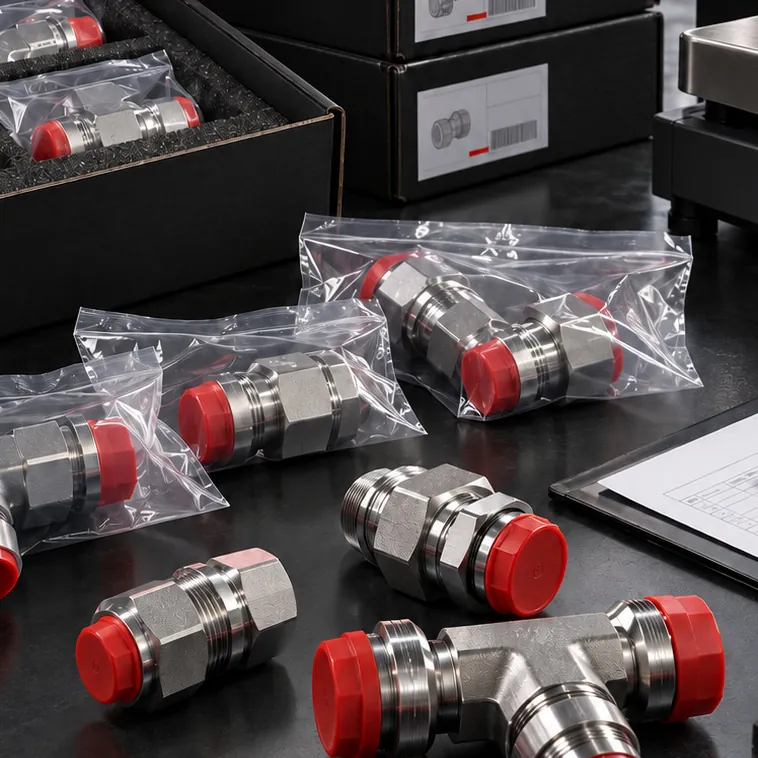
Standard sizes in stock are ready to ship within 1-3 business days on average; standard production items are scheduled within 5-10 business days on average, hose assemblies made up to length within 5-15 business days on average, and custom-size and project manufacturing within 10-20 business days on average after technical approval. For offshore shipments, parts are packed separately by size and order group; threads and ports are closed off with protective caps, and quantities, product types and a final visual check are verified before dispatch. The logistics point where the packages will be transferred to the vessel or platform, and the delivery terms, are agreed when the order is placed.
Applications
Teams in Offshore & Drilling that need fittings, hose assemblies and custom parts.
Stainless steel hose ends, flanges and adapters for deck cranes, pipe handling systems and power unit lines.
316L fittings for lifting equipment, auxiliary control circuits and measurement lines.
Spare hose assemblies and conversion adapters for deck machinery, crane and hatch cover systems.
Manifold, filter and pump outlet connections for marine-type power units.
Spare parts kits to be sent to site; non-standard fittings produced from samples.
Hydraulic lines on lifting and mooring equipment operating in salt-laden environments.
Gallery
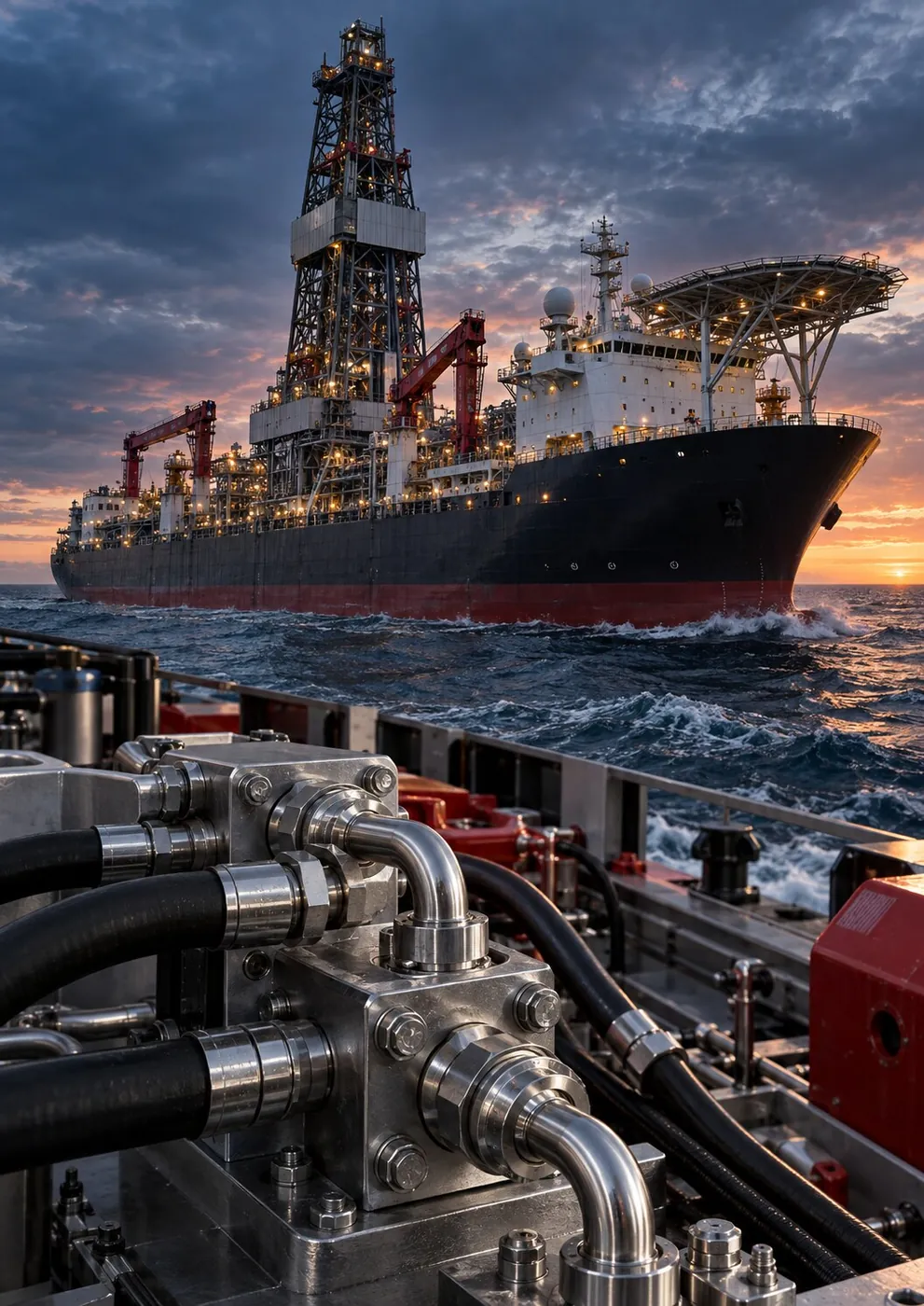
Drillship with hydraulic hose lines on deck (illustrative image)
 Offshore platform operating in fog (illustrative image)
 Offshore support vessel in port (illustrative image)
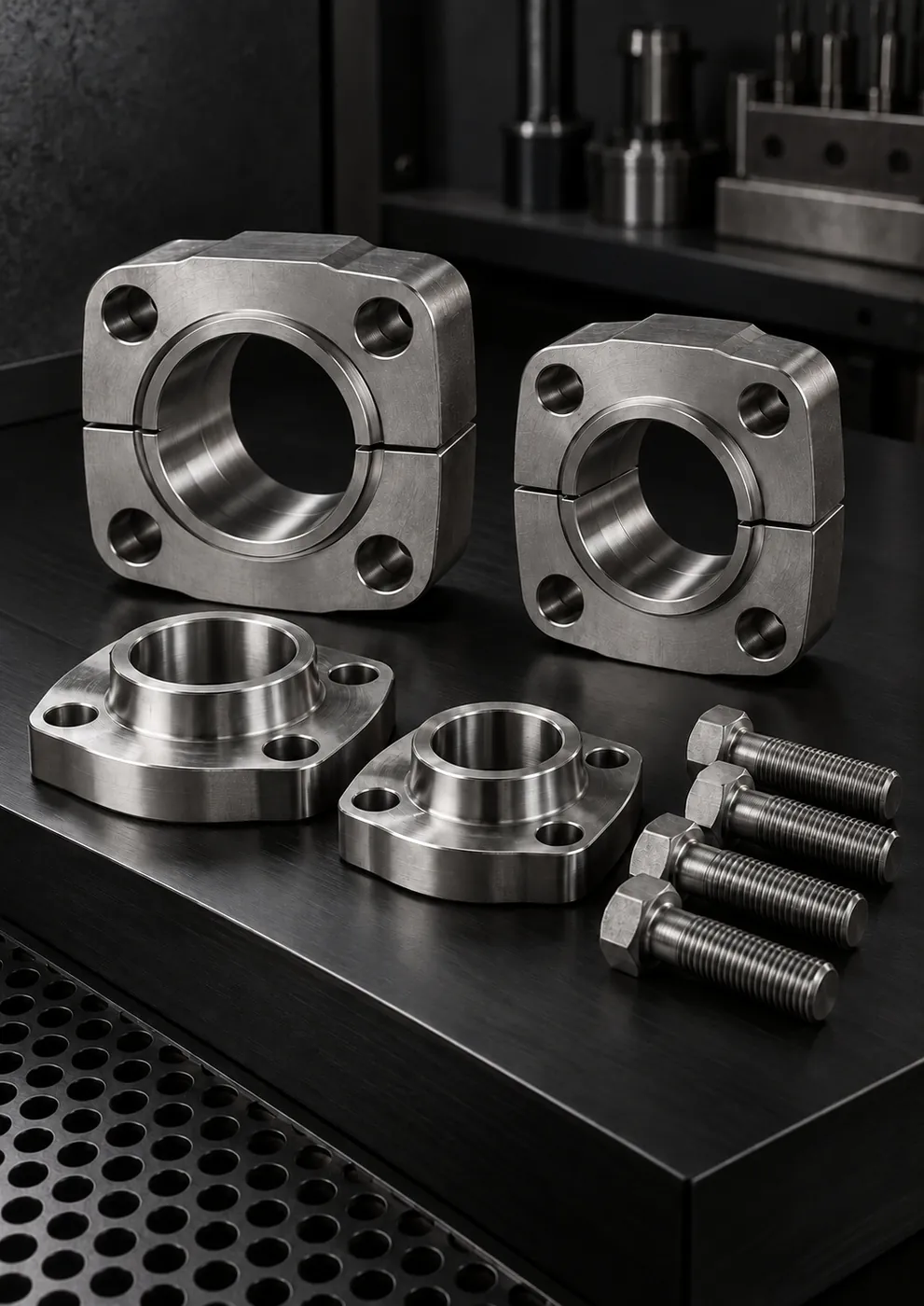 SAE flanges and bolts for high-pressure main lines (illustrative image)
Twin-ferrule instrumentation fittings for measurement and control lines (illustrative image)
Knowledge Center
In a twin-ferrule fitting, the front ferrule provides the seal and the back ferrule grips the tube. For correct installation, the tube is cut square…
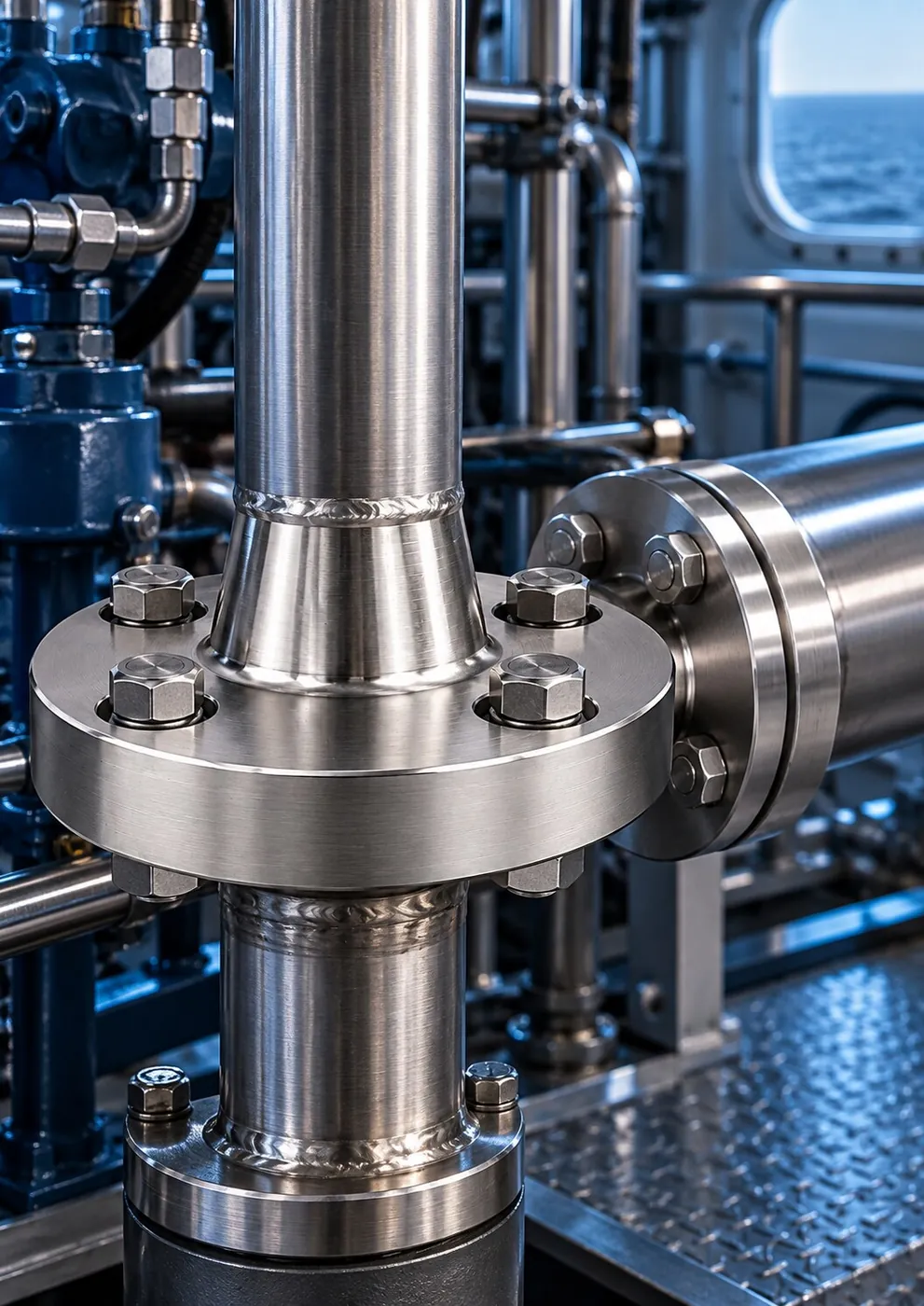
In saltwater environments, the baseline material is AISI 316L; its molybdenum content increases resistance to chloride-induced pitting and crevice…
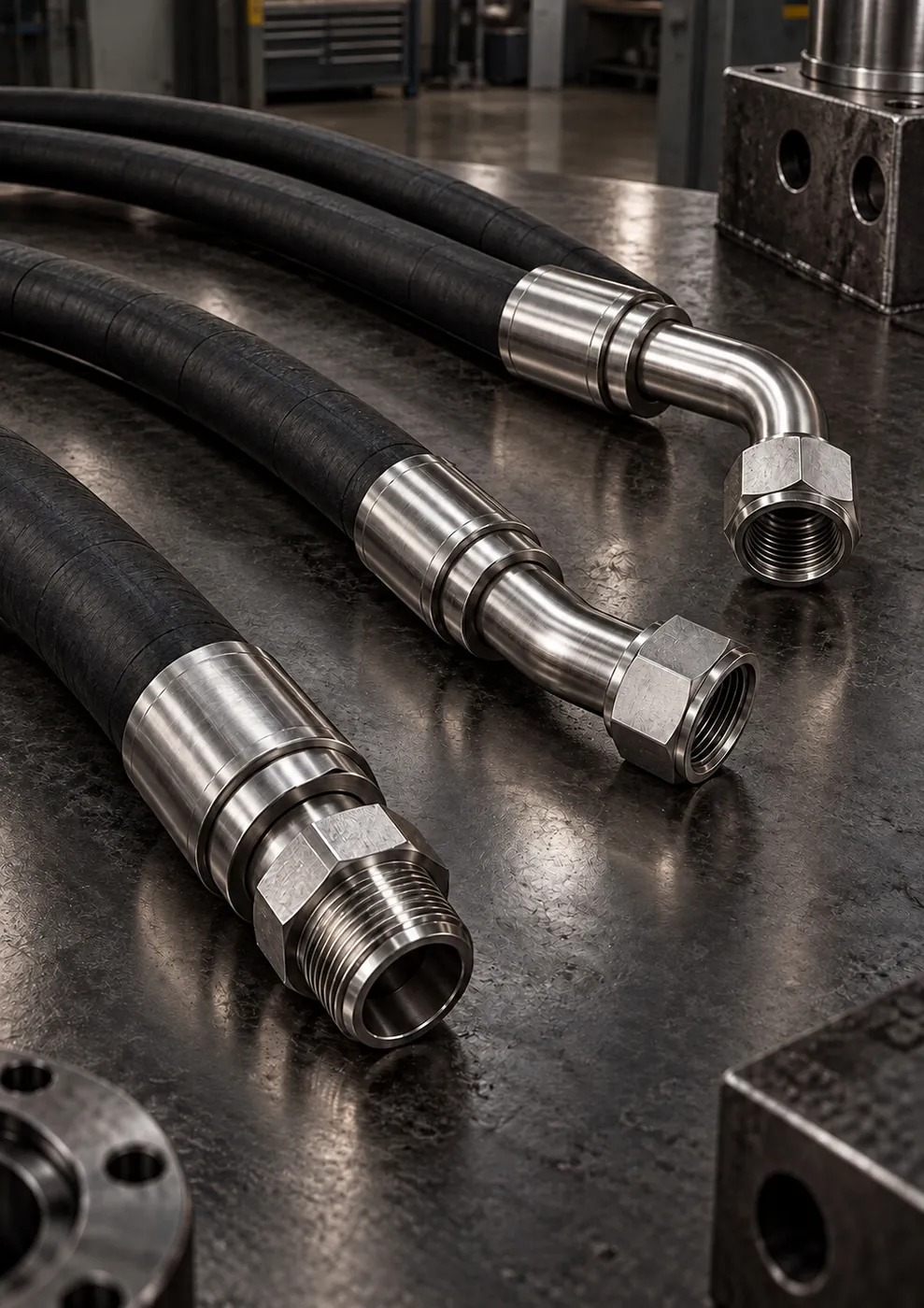
The right hose assembly is defined by seven pieces of information: inside diameter and length, temperature, application conditions, fluid, working…
Frequently asked questions
If your question isn't answered here, write to us and we'll pin down the size, thread standard and material together.
Send us your questionAISI 316L is a common and suitable choice for most hydraulic fittings in marine atmospheres. However, some project specifications may call for higher-alloy materials in special cases, such as exposed small-bore tubing in hot climates. Since our raw material is 316/316L, we recommend including the material class from your specification in your quote request.
Safety-critical systems such as well control are subject to their own design and certification requirements; we make no claim to supply certified parts for this equipment itself. For the auxiliary line, panel and power unit connections around these systems, we provide support after clarifying the applicable specification together with the operator's engineering team.
The connection type and thread standard at both ends, the end angles, hose inside diameter, overall length and working pressure are sufficient. If there is an orientation offset between two angled ends, showing it in a photo prevents mistakes. Hose assemblies crimped to length are prepared within 5-15 business days on average; hose ends and adapters in stock are ready to ship within 1-3 business days on average. Custom parts produced from technical drawings or samples are scheduled within 10-20 business days on average after technical approval.
Large threaded connections require very high tightening torque and generous wrench access, and the risk of thread damage increases on disassembly. With SAE flanges, sealing is provided by an O-ring and the connection is made up with bolts, which makes assembly and disassembly easier in tight spaces. The choice between Code 61 and Code 62 is based on nominal size, working pressure and port geometry.
Stainless steel bodies generally have no problem with these fluids; what really needs to be checked is the O-ring and seal material. Once you share the fluid type and its manufacturer's seal recommendation, the sealing element is specified accordingly.
Parts are packed separately by size and order group, and threads and ports are closed off with protective caps. Quantities, product types and a final visual check are verified before dispatch. The logistics point for transfer to the vessel or platform and the delivery terms are agreed when the order is placed.
Quote
Send the equipment list, port sizes and the project specification, if any; let's confirm material suitability and the lead time plan together.
Offshore & Drilling request form
Other sectors