


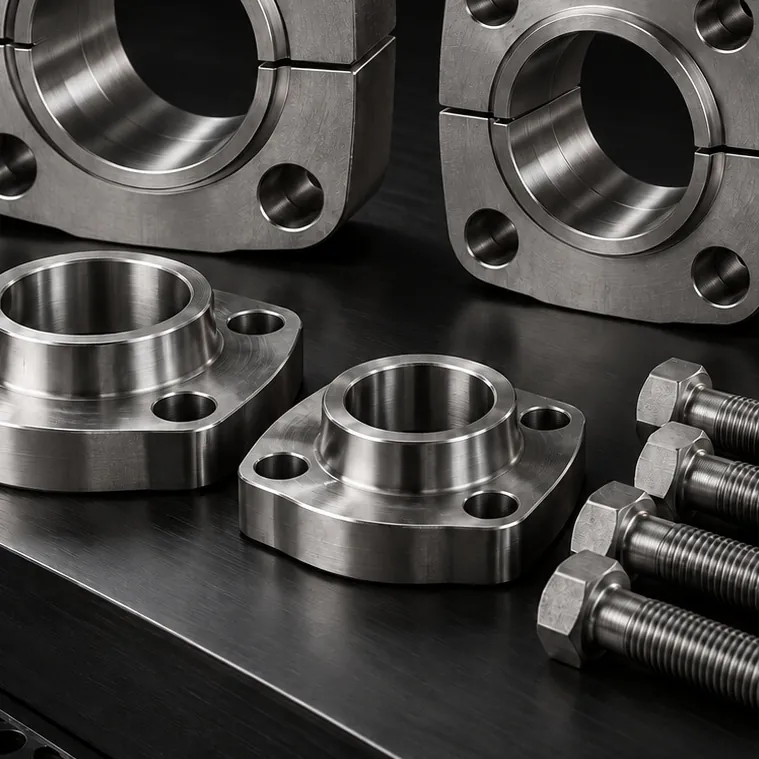
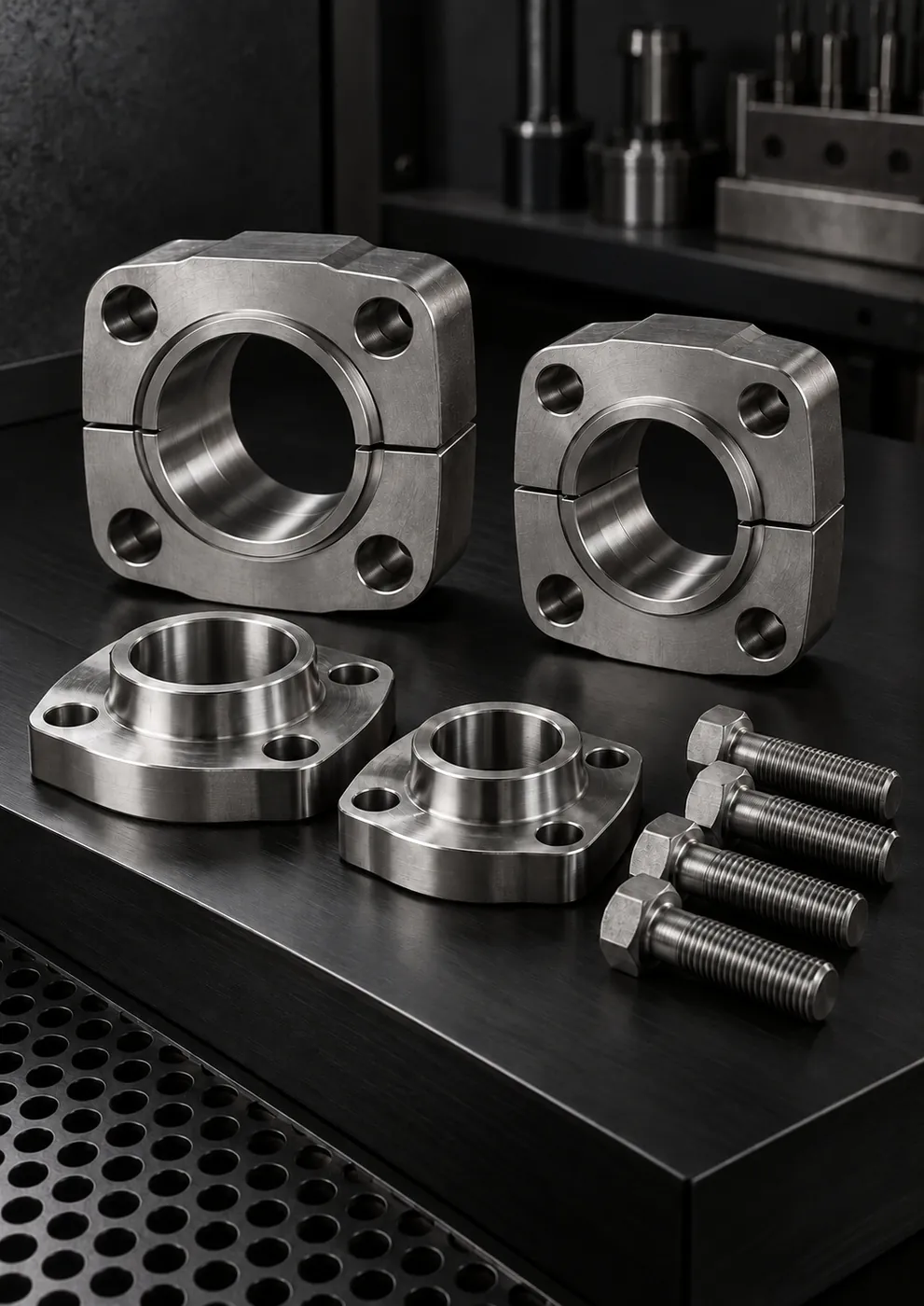
 SAE Flanges (Code 61 / 62)
SAE Code 61 Split Flange Clamp
Details & quote
Product group
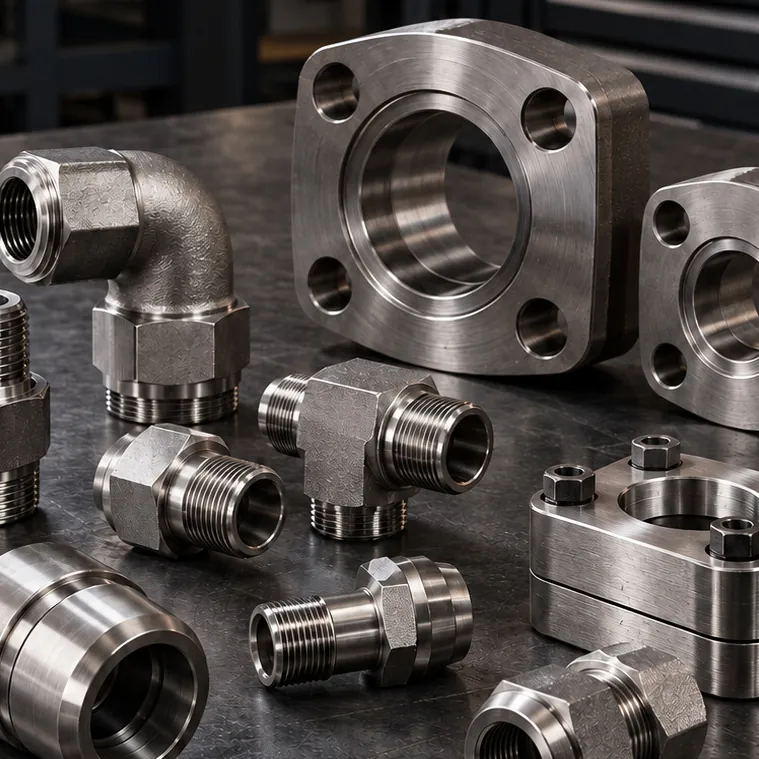
ISO 6162 / SAE J518 Code 61 (3000 PSI) and Code 62 (6000 PSI) flanges, split flanges, clamps, mating flanges and flange blocks.
 SAE Flanges (Code 61 / 62)
 SAE Flanges (Code 61 / 62)
 SAE Flanges (Code 61 / 62)
 SAE Flanges (Code 61 / 62)
Selection guide
On large-bore, high-pressure hydraulic lines, SAE flanges provide a safer and more service-friendly connection than threaded fittings. The flange head on the end of the hose or tube is clamped against the port with four bolts, using two split flange halves or a one-piece flange; sealing is provided by the O-ring on the face of the head. Because the connection is not rotated, the hose is connected without twisting, and installation is easier in tight spaces where a wrench will not fit on large sizes. ISO 6162-1 defines the Code 61 series (called SAE 3000 in the field) and ISO 6162-2 the Code 62 series (SAE 6000).
| Feature | Code 61 (SAE 3000) | Code 62 (SAE 6000) |
|---|---|---|
| Standard | ISO 6162-1 / SAE J518 | ISO 6162-2 / SAE J518 |
| Common name | 3000 PSI series | 6000 PSI series |
| Flange head and bolt spacing | Thinner head, narrower bolt spacing | Thicker and wider head, wider bolt spacing |
| Typical use | Supply, return and suction lines | High-pressure supply, presses and power units |
"3000 PSI" and "6000 PSI" are series names; the permissible working pressure varies with nominal size and, in Code 61, drops at larger sizes. The pressure rating should be checked in the table for the size concerned. Even at the same nominal size, the two series are not interchangeable.
The choice between Code 61 and Code 62 should be based on nominal size, working pressure, port geometry and installation space. The series of an existing port is identified by measuring the bolt spacing and the diameter and thickness of the flange head. Whether the bolt thread is inch (UNC) or metric must also be checked separately; ISO 6162 covers both bolt options. AISI 316/316L options are the preferred choice in plants where corrosion resistance is important.
The O-ring groove and port face must be clean and free of scratches; the O-ring should be lightly lubricated with a suitable oil. The split flanges are seated parallel to the head, and the bolts are tightened first by hand, then in a criss-cross pattern and in stages up to the table torque. Fully tightening one bolt on its own tilts the flange and crushes the O-ring on one side.
Press, mill roll and power unit lines in rolling mills; lifting equipment and power units on drillships; compact power units in the defense industry; corrugated board (corrugator) machine hydraulics in board mills; and pump outlets in ship engine rooms.
Not sure about the right size?
Send the sample, the technical drawing or your caliper measurements, and we'll confirm the thread standard and the matching part together.
+90 545 206 13 74Knowledge Center
Technical articles on selecting, installing and maintaining the products in this group.
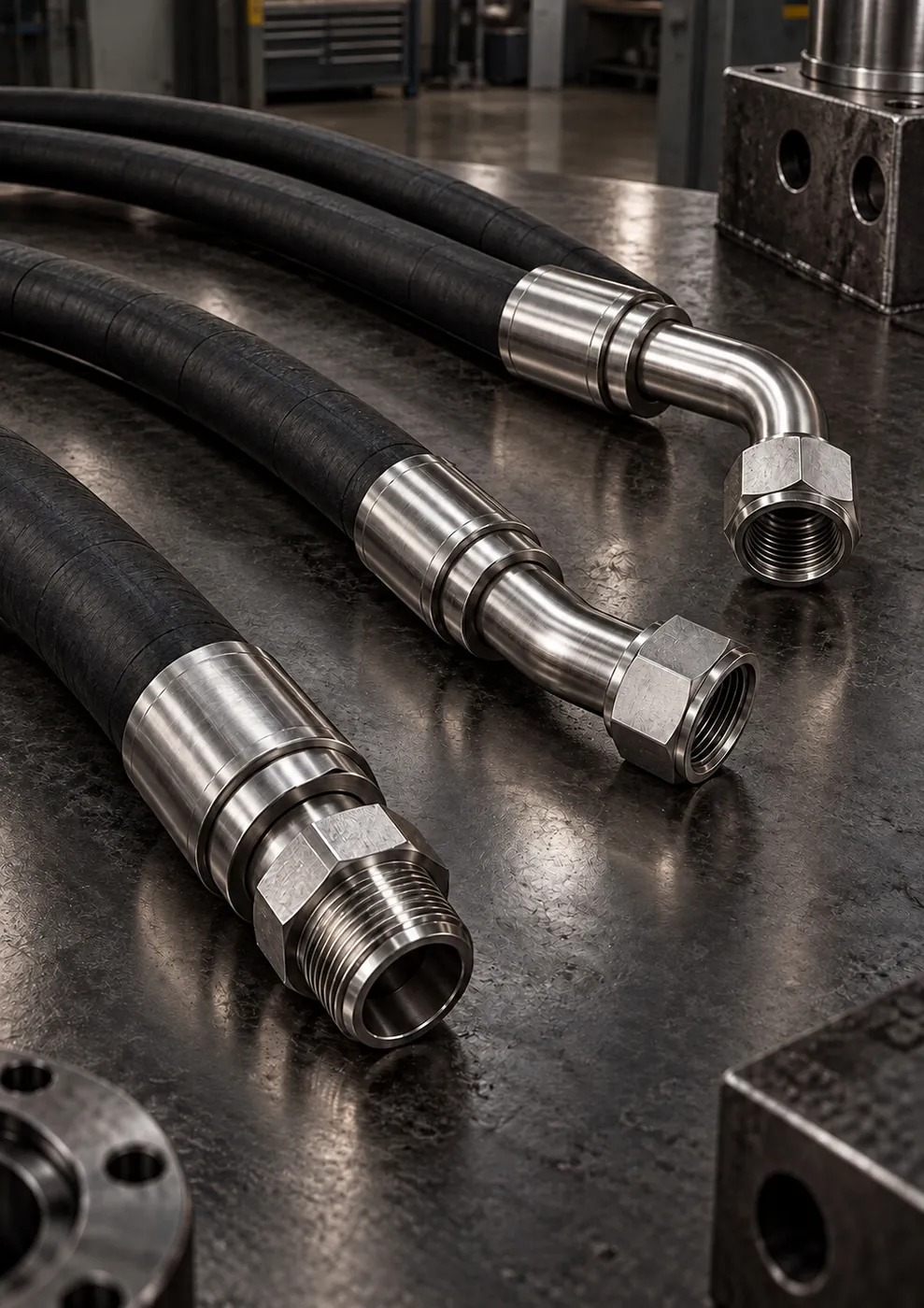
The right hose assembly is defined by seven pieces of information: inside diameter and length, temperature, application conditions, fluid, working…
Code 61 (ISO 6162-1) and Code 62 (ISO 6162-2) flanges are not interchangeable, even at the same nominal size: the Code 62 flange head is thicker and…
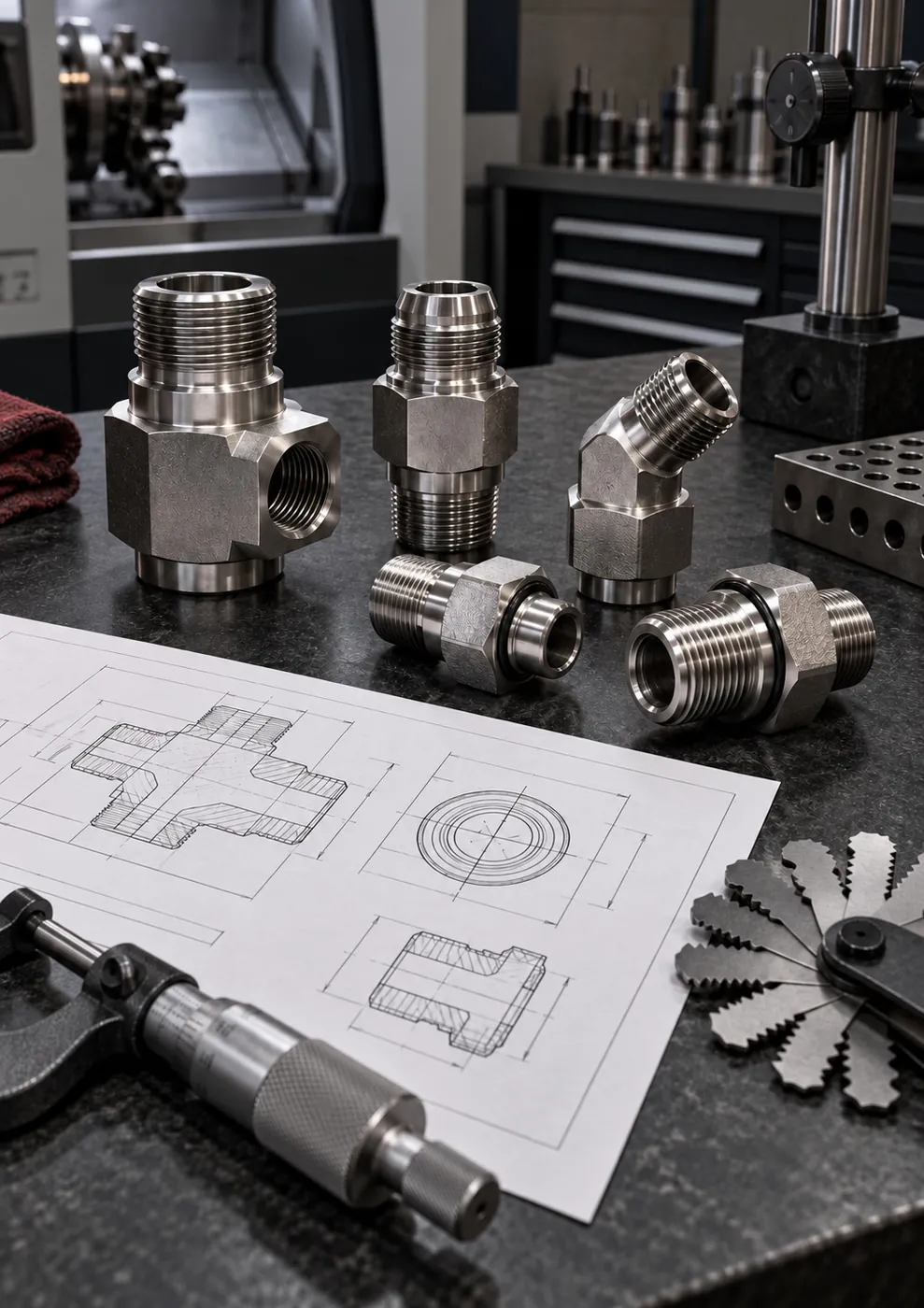
When a standard part won't fit, custom manufacturing starts with a sample, a dimensioned technical drawing or dimensional data. The thread standard…
FAQ
If your question isn't answered here, message us on WhatsApp with dimensions or a photo, and our technical team will answer directly.
Ask on WhatsAppNo. 3000 PSI and 6000 PSI are the common names of the Code 61 and Code 62 series. The permissible working pressure varies with nominal size; in Code 61 the rating drops at larger sizes. Your line pressure and flange size should be evaluated together and checked against the relevant table.
Measure the center-to-center distance of the bolt holes in both directions and the diameter and thickness of the flange head; also check the bolt thread with a thread pitch gauge. At the same nominal size, Code 62 has a thicker, wider head and wider bolt spacing. Send us the measurements and a photo, and we will confirm the series with you.
ISO 6162 defines flanges with both UNC (inch) and metric bolts. The port thread and the bolt must be the same standard; because inch and metric threads are close to each other in some sizes, a bolt can be forced in and damage the port. Check the existing bolt with a thread pitch gauge.
The most common causes are tightening the bolts one at a time instead of in a criss-cross pattern, forcing a flange of the wrong series into place, a dirty or scratched O-ring groove, and an O-ring of the wrong size or material. An extruded O-ring is not reused; the groove is cleaned, the correct O-ring is fitted and the bolts are tightened in stages.
A flange block replaces several fittings by combining elbow, spacer, reducer or distribution functions in a single body. It reduces the number of leak points and keeps the line compact in tight spaces. Geometries that standard blocks cannot handle are machined from a technical drawing or sample.