


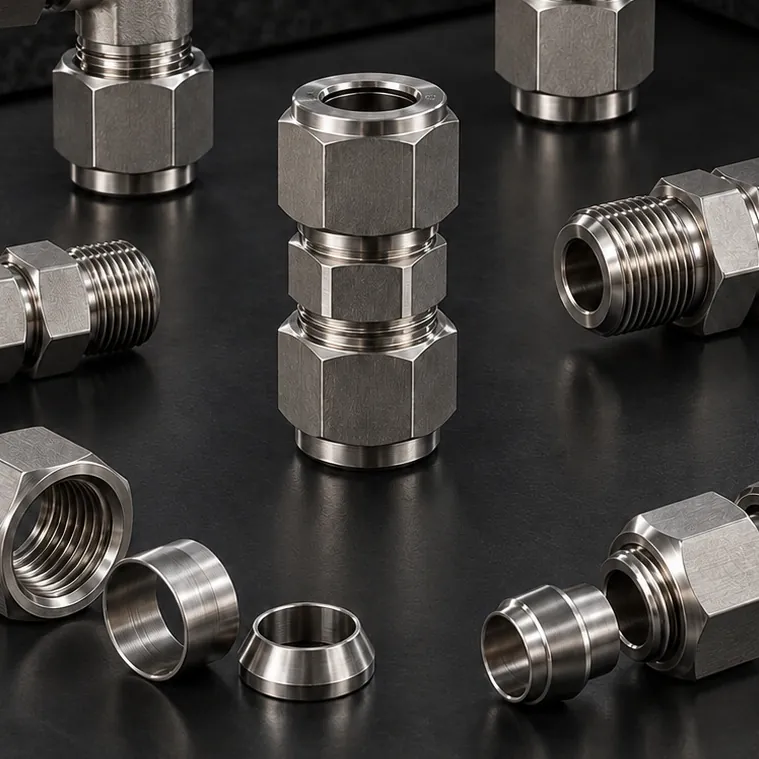
 Twin Ferrule Instrumentation Fittings
Twin Ferrule Straight Union
Details & quote
Product group
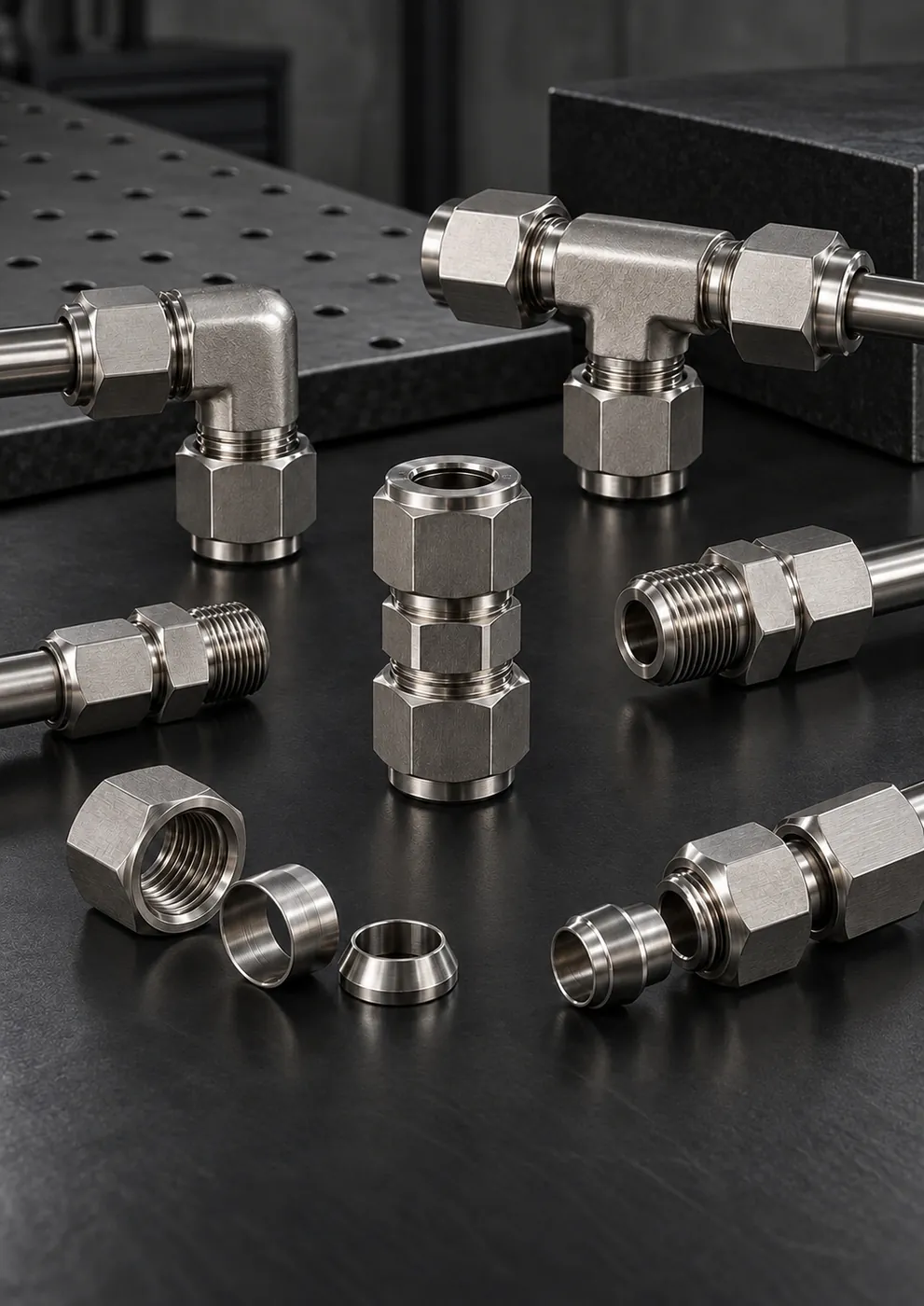
Twin ferrule straight unions, union elbows, union tees, male connectors and adapters for small-diameter measurement, control and sample lines.
 Twin Ferrule Instrumentation Fittings Twin Ferrule Instrumentation Fittings Twin Ferrule Instrumentation Fittings Twin Ferrule Instrumentation Fittings
Selection guide
Twin ferrule fittings (instrumentation fittings, also called double ferrule compression fittings) grip the tube in a controlled way on small-diameter measurement, control and sample lines, giving neat and repeatable assembly. When the nut is tightened, the front ferrule seats against the body cone and the tube to create the seal; the back ferrule grips the tube and holds it against vibration. The connection requires no welding and can be disconnected and remade. Straight unions, union elbows, union tees, male connectors and adapters are chosen to suit different line layouts.
The tube must be cut square and clean, and deburred. The tube is pushed all the way to the tube stop inside the body; after the nut is tightened by hand, it is turned with a wrench by the number of turns specified by the manufacturer. After assembly, adequate tightening can be checked with a gap inspection gauge. Bodies, nuts and ferrules from different manufacturers must not be mixed. When a disconnected joint is remade, the nut is brought back to its previous position and tightened slightly. Lines must be supported with clamps; the weight of the tube and vibration must not bear on the connection.
Transmitter and analyzer lines in chemical plants, instrumentation panels on offshore platforms, sample and control lines in food plants, hydraulic test benches in aviation, and compact control circuits in the defense industry. For line layout and tubing workmanship, see also our instrumentation tubing service page.
Not sure about the right size?
Send the sample, the technical drawing or your caliper measurements, and we'll confirm the thread standard and the matching part together.
+90 545 206 13 74Knowledge Center
Technical articles on selecting, installing and maintaining the products in this group.
In a twin-ferrule fitting, the front ferrule provides the seal and the back ferrule grips the tube. For correct installation, the tube is cut square…
FAQ
If your question isn't answered here, message us on WhatsApp with dimensions or a photo, and our technical team will answer directly.
Ask on WhatsAppWhen the nut is tightened, the front ferrule seats against the body cone and the tube surface to create the seal; the back ferrule grips the tube and keeps it from slipping under vibration and pressure. No tape or liquid sealant is applied to the threads for sealing.
A union joins two tubes on the same axis; both of its ends are twin-ferrule. A connector has one twin-ferrule end and one threaded end, and connects the tube to a port. An adapter converts between different connection types or sizes; for example, from a tube end to a different thread or to another tube size.
It depends on the port thread of the instrument or valve it will connect to. NPT is common on American-made transmitters and valves, and BSPT or BSPP on European equipment. At 1/2 and 3/4 inch the two standards have the same pitch, so the wrong part can thread in for a few turns; the port thread should be verified from the instrument label or with a thread pitch gauge.
The tube should be supported with clamps close to the connections, and heavy valves and manifolds should be secured separately. On lines connected to vibration sources such as pumps or compressors, a small loop or a flexible connection keeps the vibration from bearing on the fittings.