Tuzla, Istanbul

Hydraulic terms

Glossary of Hydraulic Terms

Short definitions of hydraulic fitting, thread, flange, hose and stainless steel material terms: BSP, NPT, JIC, ORFS, DIN 2353, dash size, bonded seal, 316L and more.

Quick answer

This glossary gives short definitions of 45 terms that come up when selecting hydraulic fittings: thread standards (BSP, NPT, UNF), connection types (JIC 37°, ORFS, 24° cone, SAE flange), size concepts (dash, DN, PN, TPI) and stainless steel material terms (AISI 316, 316L, galvanic corrosion). You can read the terms alongside the relevant size chart.

45 terms

Terms and definitions

24° cone
The 24° internal cone in a DIN 2353 / ISO 8434-1 fitting body. The cutting ring or O-ring cone end seats in this cone to make the seal; it does not mate with JIC 37° or SAE 45° cones.
2SN / 4SH
Hydraulic hose types. 2SN, defined in EN 853, is a hose reinforced with two layers of steel wire braid and a thin outer cover. 4SH, defined in EN 856, is reinforced with four spiral-wound steel wire layers and is made for high pressure and pressure-shock service. The working pressure by ID is read from the standard's table.
AISI 316 (1.4401)
Austenitic chromium-nickel-molybdenum stainless steel. Its molybdenum content of about 2–3% gives it a clear advantage over grade 304 against pitting corrosion in chloride environments; it is widely used in marine and chemical applications.
AISI 316L (1.4404)
The low-carbon (max. 0.03% C) version of 316. Because it lowers the risk of chromium carbide precipitation at grain boundaries during welding, it is preferred for welded nipples, flanges and pipelines; its corrosion resistance is similar to that of 316.
AISI 316Ti (1.4571)
Titanium-stabilized 316. Titanium binds the carbon, reducing the risk of intergranular corrosion at high temperature and after welding; it is common in Europe, particularly in Germany.
Ball valve
A valve that opens and closes by turning a ball with a bore through its center a quarter turn. When fully open it offers little resistance to flow; it is used for on-off service, not for flow control.
Banjo fitting
A fitting with a ring-shaped body attached to the port by a bolt drilled through its center (banjo bolt). The seal is made by washers on both faces of the ring; it allows the connection to be turned in the required direction in tight spaces.
Bonded seal
A seal made by vulcanizing an elastomer lip to the inner edge of a metal washer. It seals between a BSPP or metric parallel male end and the port face.
BSP
British Standard Pipe; a family of pipe threads with a 55° Whitworth profile and rounded crests and roots. There are two types: parallel BSPP (G, ISO 228-1) and tapered BSPT (R, Rc, ISO 7-1).
BSPP
Parallel BSP thread; designated with the letter G (G 1/2) and defined in ISO 228-1. The thread does not seal; the seal is made with a bonded seal, an O-ring or a 60° cone seat.
BSPT
Tapered BSP thread (ISO 7-1). R denotes a male tapered, Rc a female tapered and Rp a female parallel thread. With the 1:16 taper the seal is made on the thread, with PTFE tape or liquid thread sealant.
Check valve (NRV)
A valve that lets flow pass in one direction and closes automatically in the reverse direction (non-return valve). On spring-loaded types, the minimum pressure needed to open the valve is given as the cracking pressure.
Crimping
Radially compressing the hose fitting and ferrule onto the hose in a crimping machine. The crimp diameter is set according to the hose and fitting manufacturer's table and checked by measurement.
Cutting ring (ferrule)
The ring that fits over the tube in a 24° cone fitting. As the nut is tightened, it moves into the cone and its front edge bites into the tube; it holds the tube and makes the seal. A stainless steel cutting ring is used in a stainless steel body.
Dash size
A number that gives a size in sixteenths of an inch (-4, -8, -16). On tube connections (JIC, ORB, ORFS) it indicates the tube OD; on hose, the ID: -8 = 8/16" = 1/2".
DIN 2353
The German standard for 24° cone tube fittings with cutting rings; it defines the LL, L and S series. It has been replaced by ISO 8434-1, but the name is still widely used in the market. These fittings are also known as bite-type or cutting ring fittings.
DN
Nominal diameter (Diameter Nominal); a dimensionless, approximate millimeter value. It has different equivalents for pipe and hose: 1/2" pipe is written as DN 15 and 1/2" hydraulic hose as DN12.
Galvanic corrosion
Corrosion that accelerates on the more active metal when two metals with different electrochemical potentials are in contact in an electrolyte such as moisture or saltwater. In a joint between stainless steel and carbon steel or aluminum, the carbon steel or aluminum is the side that corrodes; using the same material or electrical insulation reduces the risk.
Hose ferrule (socket)
The outer sleeve that fits over the hose and, when crimped, clamps the fitting onto the hose. It is selected by hose type (1SN, 2SN, 4SH etc.); some types require the outer cover to be skived before crimping.
Hose fitting (hose end)
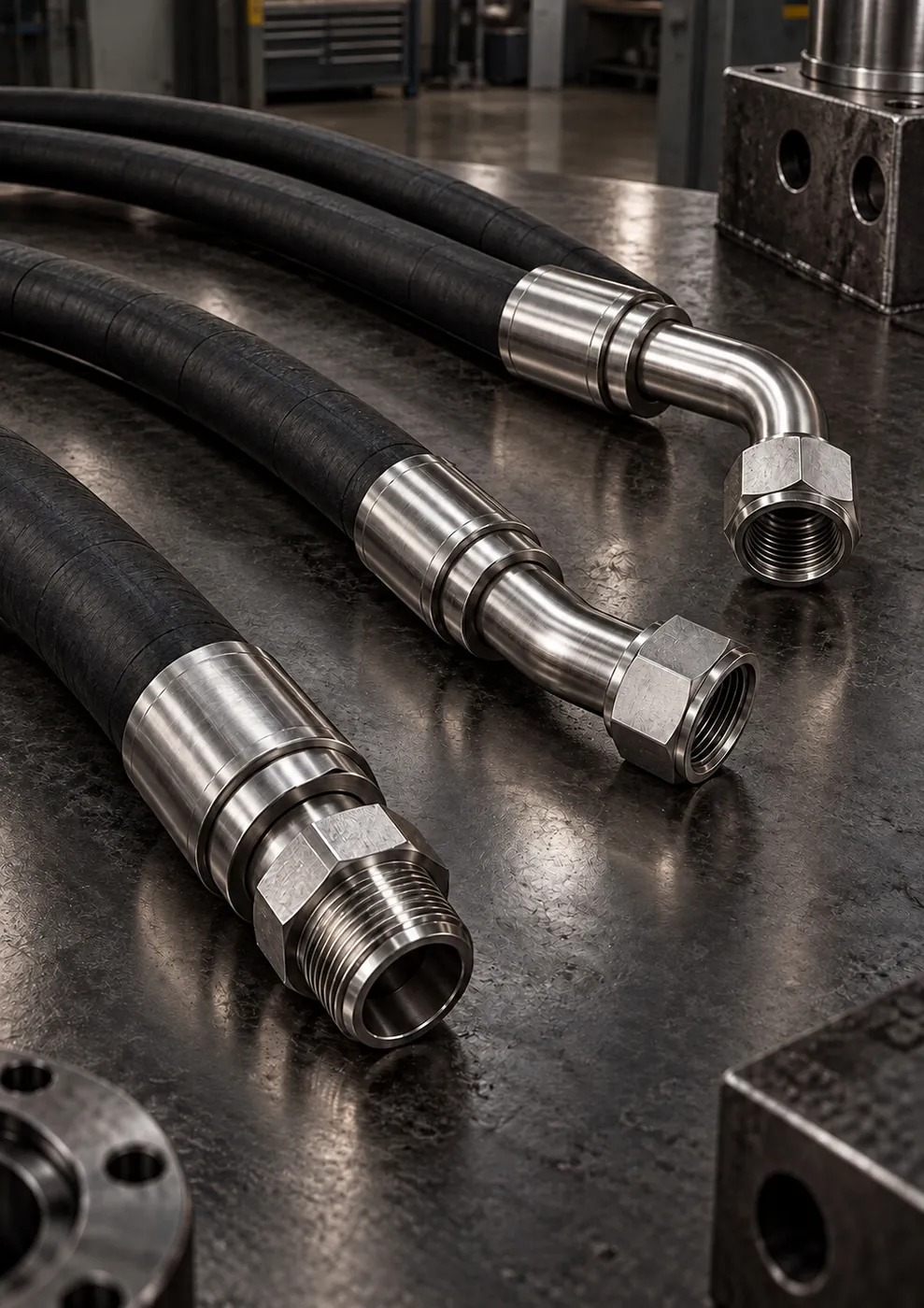
The body crimped onto the end of a hose, carrying a JIC, ORFS, BSP, metric or flange connection at its other end. There are straight, 45° and 90° types; it is crimped together with the ferrule.
ISO 8434-1
The international standard for 24° cone metal tube connections; it replaced DIN 2353. It gives the LL, L and S series, the tube and nut thread assignments, and working pressures for carbon steel bodies. Part 2 of the same series covers 37° flared (JIC) connections and part 3 covers ORFS connections.
JIC 37°
SAE J514 / ISO 8434-2 flared connection. The seal is made by metal-to-metal contact of the 37° conical faces; the UN/UNF thread only provides the clamping force. Its size is given by dash number.
L series
The light series in ISO 8434-1 / DIN 2353; it covers 6–42 mm OD tube. 12L is the L series fitting for 12 mm tube and uses an M18×1.5 nut thread.
Manifold block
A block that brings several valves and ports together in a single body, with internal passages drilled to connect them. It reduces the number of tubes and hoses, and so the number of potential leak points.
Needle valve
A valve that precisely adjusts or shuts off flow as a stem with a tapered tip (the needle) approaches its seat. It is used on gauge lines, sampling points and instrumentation circuits.
NPT
National Pipe Taper; the American pipe thread defined in ASME B1.20.1, with a 60° profile and a 1:16 taper. The seal is made on the thread and a sealant is required.
NPTF
Dryseal tapered pipe thread (ASME B1.20.3). It uses the same TPI and diameters as NPT; its crests and roots are designed to interfere on tightening for a dry seal. This assurance does not apply when it is mixed with NPT.
O-ring
An elastomer seal with a circular cross-section that seals when compressed in its groove. Its size is written as ID × cross-section (e.g. 18.64 × 3.53 mm); the material (NBR, FKM etc.) is chosen to suit the fluid and temperature.
ORFS
O-ring face seal; an SAE J1453 / ISO 8434-3 connection. The O-ring in the groove on the flat face of the male part is compressed against the flat face of the female part to make the seal; the thread is UN/UNF.
Pitch
The axial distance between two adjacent thread crests. On metric threads it is written in millimeters (1.5 mm on M18×1.5); on inch threads it is calculated from TPI: pitch = 25.4 / TPI.
Pitch gauge
A measuring tool made of thin blades, each cut to a specific pitch. The blade that sits on the thread with no gaps gives the pitch (mm) or TPI; inch and metric gauges are separate.
PN
Nominal pressure (Pressure Nominal); a designation showing the pressure class of a component in bar (PN16, PN40). The actual permitted pressure is read from the relevant standard's table according to material and temperature.
psi and bar
Units of pressure. 1 bar = 14.504 psi = 0.1 MPa; 1 psi = 0.0689 bar. So 3000 psi ≈ 207 bar, 5000 psi ≈ 345 bar and 6000 psi ≈ 414 bar.
Quick coupling (quick disconnect)
A male-female pair used to connect and disconnect a hose without tools (QRC). On most types, the valves on both sides close when the coupling is disconnected; common standards are ISO 7241 and, for flat-face types, ISO 16028.
S series
The heavy series in ISO 8434-1 / DIN 2353; it covers 6–38 mm OD tube. For 6–12 mm tube it uses a nut thread one step larger than the L series: M20×1.5 on 12S.
SAE 45° flare
A 45° flared tube connection, found on refrigeration and low-pressure lines. In sizes -2, -3, -4, -5, -8 and -10 it uses the same thread as JIC, but the cones do not mate.
SAE flange Code 61 (SAE 3000)
SAE J518 / ISO 6162-1 four-bolt flange series. Under ISO 6162-1 the working pressure varies by size: 350 bar at 1/2" and 3/4", 160 bar at 3". "3000" is a series name, not the pressure of every size.
SAE flange Code 62 (SAE 6000)
SAE J518 / ISO 6162-2 four-bolt high-pressure flange series; under ISO 6162-2 the working pressure is 420 bar in all sizes. At the same nominal size it has a larger bolt spacing and a thicker flange head than Code 61.
SAE ORB
SAE O-ring boss; an SAE J1926 / ISO 11926 port connection. The O-ring under the hex of the parallel UN/UNF male end is compressed into the chamfer at the port mouth to make the seal.
Swivel nut
A nut that turns freely on the end of a fitting. It lets the connection be tightened without twisting the hose or tube; it is used on JIC, ORFS and 60° cone BSP hose ends.
TPI
Threads per inch; the number of threads in a 25.4 mm length. It is used instead of pitch on inch threads: 14 TPI = 1.814 mm pitch.
Twin-ferrule fitting
A compression tube fitting with two ferrules, front and back, used on instrumentation lines. The front ferrule seals between the body cone and the tube, while the back ferrule grips and holds the tube.
UN / UNC
Unified (ASME B1.1) inch thread family with a 60° profile. UNC is the coarse-pitch series used on bolts (e.g. the 3/8-16 UNC SAE flange bolt). The UN designation refers to the constant-pitch series and is seen on large fitting threads (1-1/16-12 UN).
UNF
Unified Fine; the fine-pitch Unified thread series. It is used on the smaller sizes of JIC, ORB and ORFS connections: 7/16-20 UNF, 3/4-16 UNF.
Working pressure
The highest pressure permitted for a component in continuous service. Hydraulic hose standards generally specify a burst pressure of four times the working pressure. The working pressure of a line is limited by the lowest-rated part among the hose, fittings and adapters.

Knowledge Center

Related technical articles

FAQ

Frequently asked questions

If your question isn't answered here, message us on WhatsApp with dimensions or a photo, and our technical team will answer directly.

Ask on WhatsApp
What is the difference between a fitting and a nipple?

A fitting is the general name for a connecting part that joins tubes, hoses or ports; it usually has a sealing arrangement such as a nut, ferrule or cone. A nipple is usually a short connecting piece threaded at both ends; it is used to join two female ports or to convert from one standard to another. In the field, the two terms are often used interchangeably.

What is a bonded seal?

A bonded seal is made by vulcanizing an elastomer lip to the inner edge of a metal washer. It fits between a BSPP or metric parallel male end and the port face; since the thread does not seal, this seal makes the joint tight. Its size is selected by thread size.

What is the difference between 316 and 316L?

Both are molybdenum-alloyed austenitic stainless steels with similar corrosion resistance. 316L has a maximum of 0.03% carbon, which lowers the risk of chromium carbide precipitation at grain boundaries during welding. That is why 316L is preferred for welded nipples, flanges and pipelines.

What do DN and PN mean?

DN is the nominal diameter and gives an approximate millimeter value; PN is the nominal pressure and shows the pressure class in bar (PN16, PN40). DN has different equivalents for pipe and hose, and the actual pressure permitted by a PN rating is read from the standard's table according to material and temperature.

From chart to quote

Need a stainless steel fitting in this size?

Tell us the thread standard, size and quantity; we'll quote price and lead time for an AISI 316/316L stainless steel fitting from stock or made to order.