


 Quick Disconnect Couplings
Quick Disconnect Coupling (BSP)
Details & quote
Product group
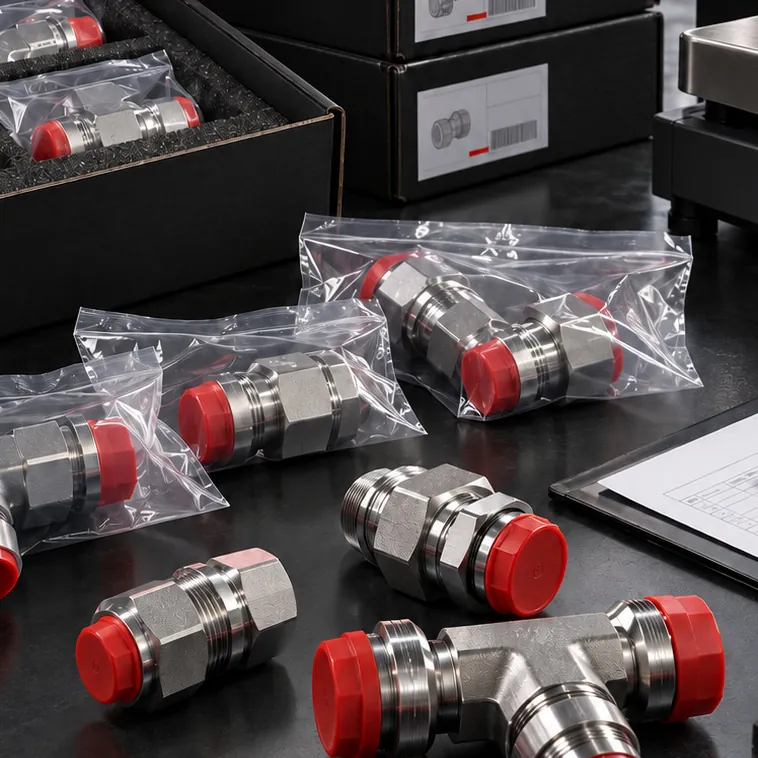
Stainless steel BSP quick disconnect couplings for tool-free connection on lines that are disconnected and reconnected frequently. Type and size are confirmed per request.
Quick Disconnect Couplings Selection guide
Quick disconnect couplings (quick couplers; known in Turkish field usage as "otomatik rakor") provide tool-free connection at test points, on mobile equipment and on hose lines that are disconnected and reconnected frequently. A coupling consists of a male and a female half; when the halves are separated, the valves inside them close and keep most of the fluid inside the line. This group includes stainless steel-bodied couplings with BSP threads; type, size and seal material are confirmed against the request before supply.
| Type | Characteristics | Where? |
|---|---|---|
| Ball-locking, with poppet or ball valve (ISO 7241 type) | Common and economical; a small amount of fluid loss on disconnection and possible air inclusion on connection | General hydraulics, test and service lines |
| Flat-face (ISO 16028 type) | Very low fluid loss and air inclusion on disconnection; the face is easy to wipe clean | Areas that must stay clean, contamination-sensitive systems |
| Threaded-locking | Locked with a threaded nut; resistant to shock and vibration | Heavy-duty lines with pressure spikes and vibration |
The faces of both halves must be wiped before connecting; any dirt passes through the coupling straight into the system. Disconnected halves must be closed with dust caps. The coupling must not carry the weight of the hose or any tensile load; the hose must be supported separately. When the body thread is connected to a port, the thread standard (BSPP or BSPT) and the sealing method are checked with the same care as for other connections.
For a quote, the working pressure, flow rate, fluid, connection thread and, if available, a photo of the existing mating half are all we need.
Mobile hydraulics and test equipment in defense and aviation, frequently disconnected lines on offshore and ship deck equipment, and sampling and service points in chemical plants. In salty, humid environments, the body and locking mechanism of carbon steel couplings rust; a stainless steel body keeps the mechanism working at these points.
Not sure about the right size?
Send the sample, the technical drawing or your caliper measurements, and we'll confirm the thread standard and the matching part together.
+90 545 206 13 74FAQ
If your question isn't answered here, message us on WhatsApp with dimensions or a photo, and our technical team will answer directly.
Ask on WhatsAppFlat-face couplings lose very little fluid on disconnection, let almost no air into the system when connected, and have faces that are easy to clean; they are preferred in contamination-sensitive systems. Ball-locking couplings with poppet valves are more common and economical; they are sufficient for general service lines.
Standard couplings cannot be connected, or are very hard to connect, while the line is under pressure. For applications that require connecting under pressure, types designed for this purpose must be selected; state this requirement in your quote request.
Halves made to the same standard profile are often interchangeable, but this is not guaranteed for every product. The safest approach is to confirm the mating part using the brand, type and a photo of the existing half.
Yes. Both names describe the same part (in Turkish, "otomatik rakor"): a coupling that is connected and disconnected without tools and that shuts off the line when separated, thanks to its internal valves. Using either term in a quote request is enough; the thread standard, size and type should be specified separately.