Marine & Shipping · Technical guide
Choosing Corrosion-Resistant Stainless Fittings for Saltwater Service
Quick answer
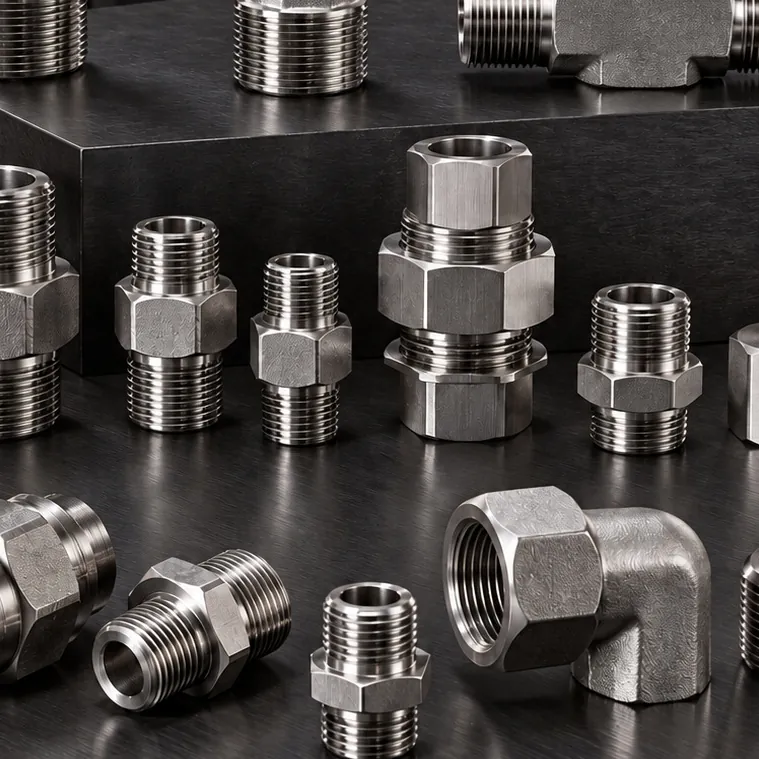
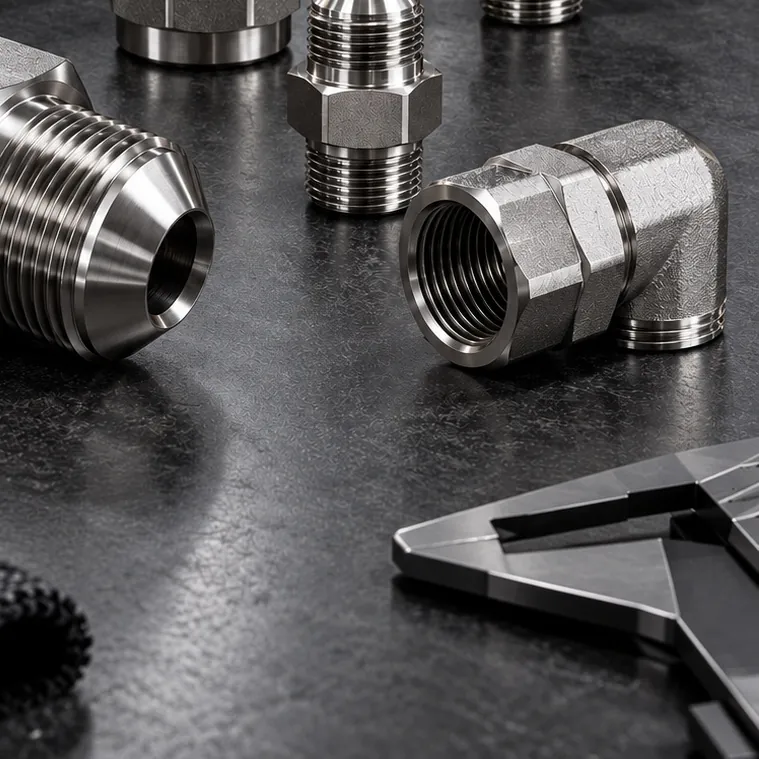
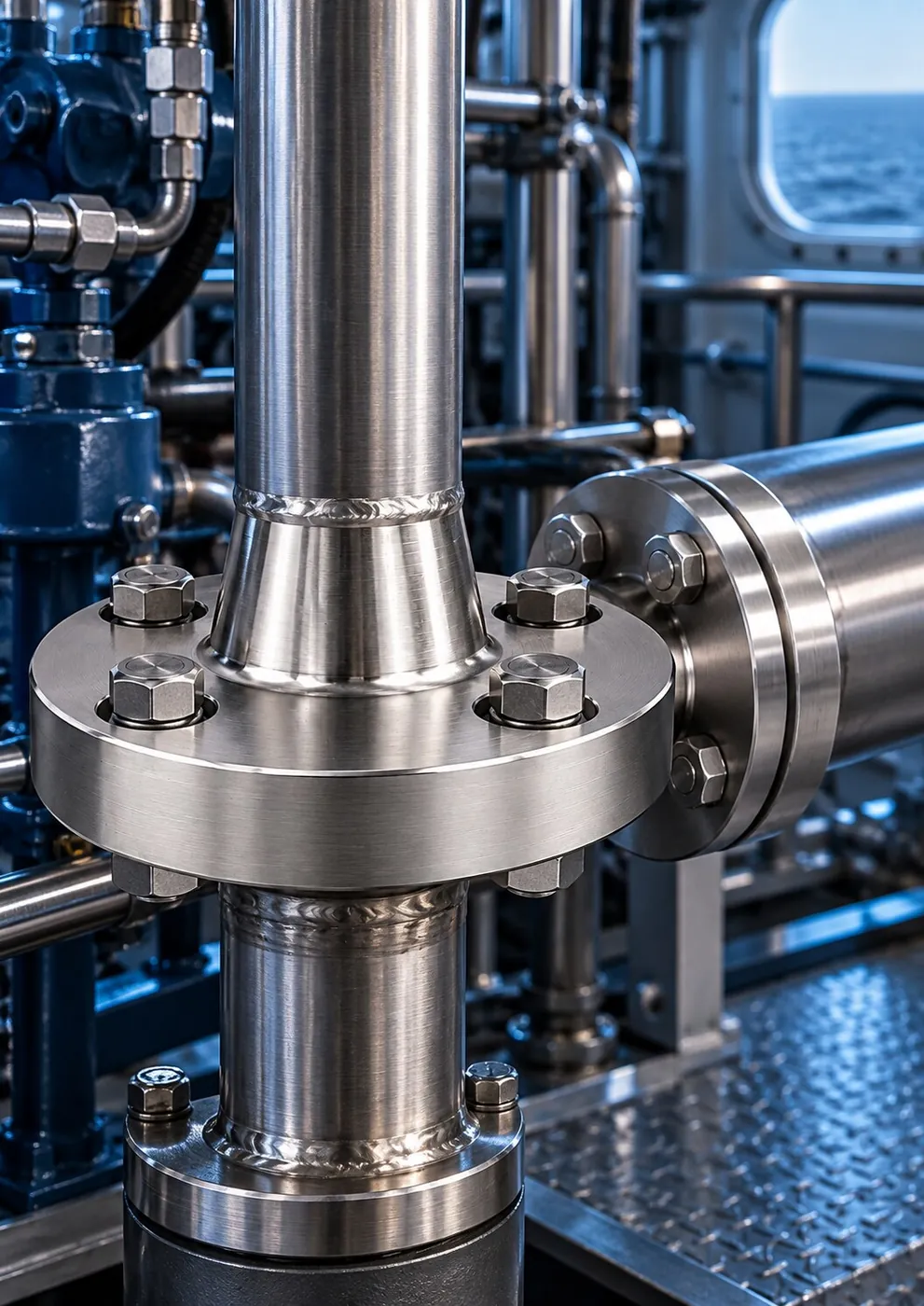
In saltwater environments, the baseline material is AISI 316L; its molybdenum content increases resistance to chloride-induced pitting and crevice corrosion. The details determine a fitting's service life as much as the material does: avoid geometry that creates crevices and deposits, isolate dissimilar metals, keep vibration away from the fitting with proper line support, and plan maintenance access and the spare parts list at the design stage.
On ships and offshore installations, a hydraulic fitting has to withstand not only pressure but also salt air, seawater spray, a hot and humid engine room and constant vibration. Under these conditions, design, installation and maintenance determine a fitting's service life as much as the material does. Below we offer a practical selection framework for shipyards, boatbuilders and ship maintenance teams.
Not every area on board is the same
| Area | Main exposure | Selection note |
|---|---|---|
| Open deck and splash zone | Saltwater spray, sunlight, wet-dry cycles | 316L fittings; simple geometry that prevents salt buildup; regular freshwater rinsing |
| Engine room | Heat, humidity, oil mist, vibration | 316/316L; vibration-tolerant connection type and robust clamping |
| Bilge and low points | Stagnant saltwater, sludge, deposits | Keep fittings out of this area where possible; if unavoidable, evaluate the material on a project basis |
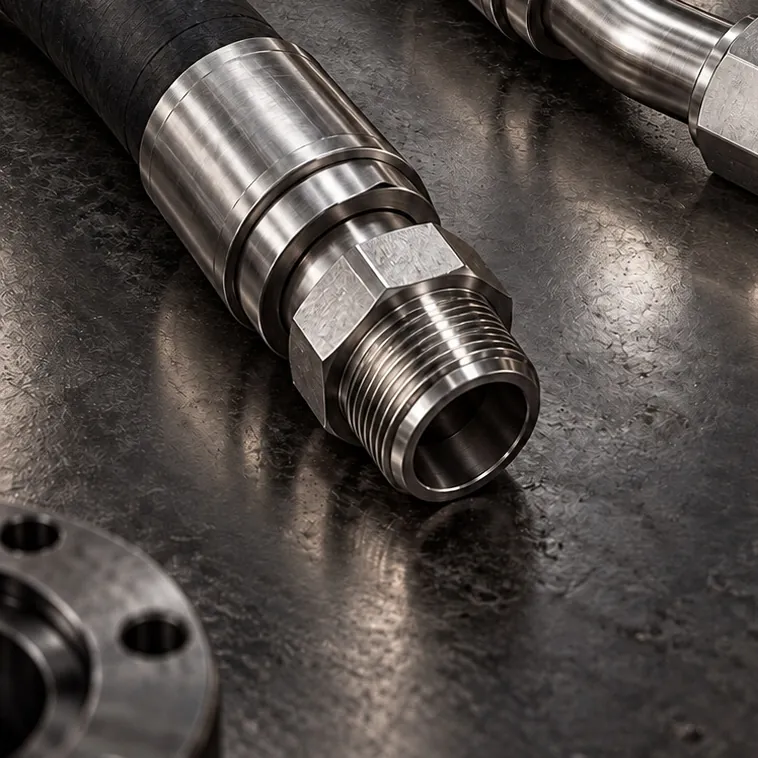
| Cranes, steering gear and deck machinery | High cycling, shock loads, outdoor exposure | 316L ends on hoses and adapters; bend radius and abrasion protection |
Hoses on deck: sunlight, ozone and abrasion
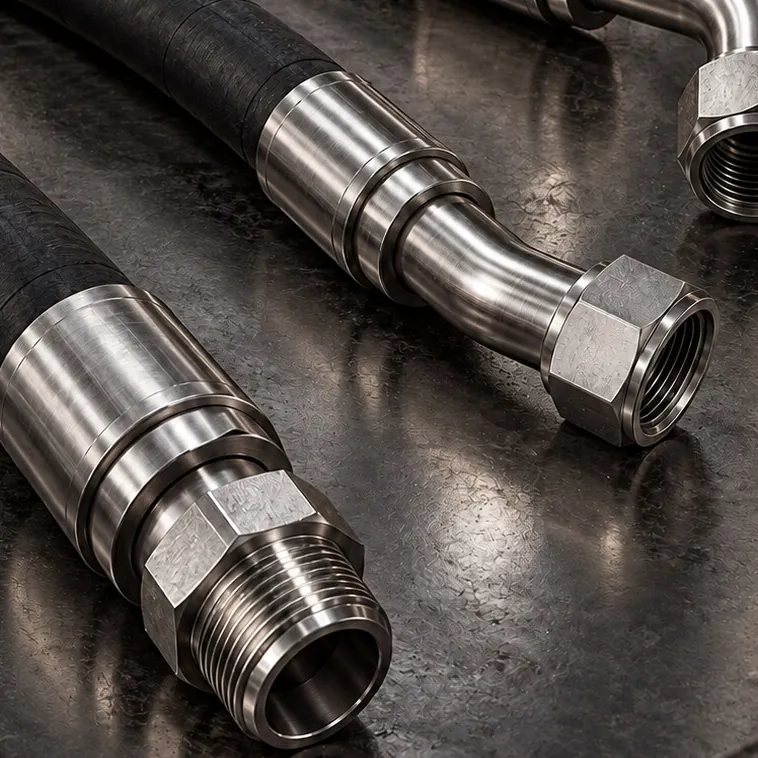
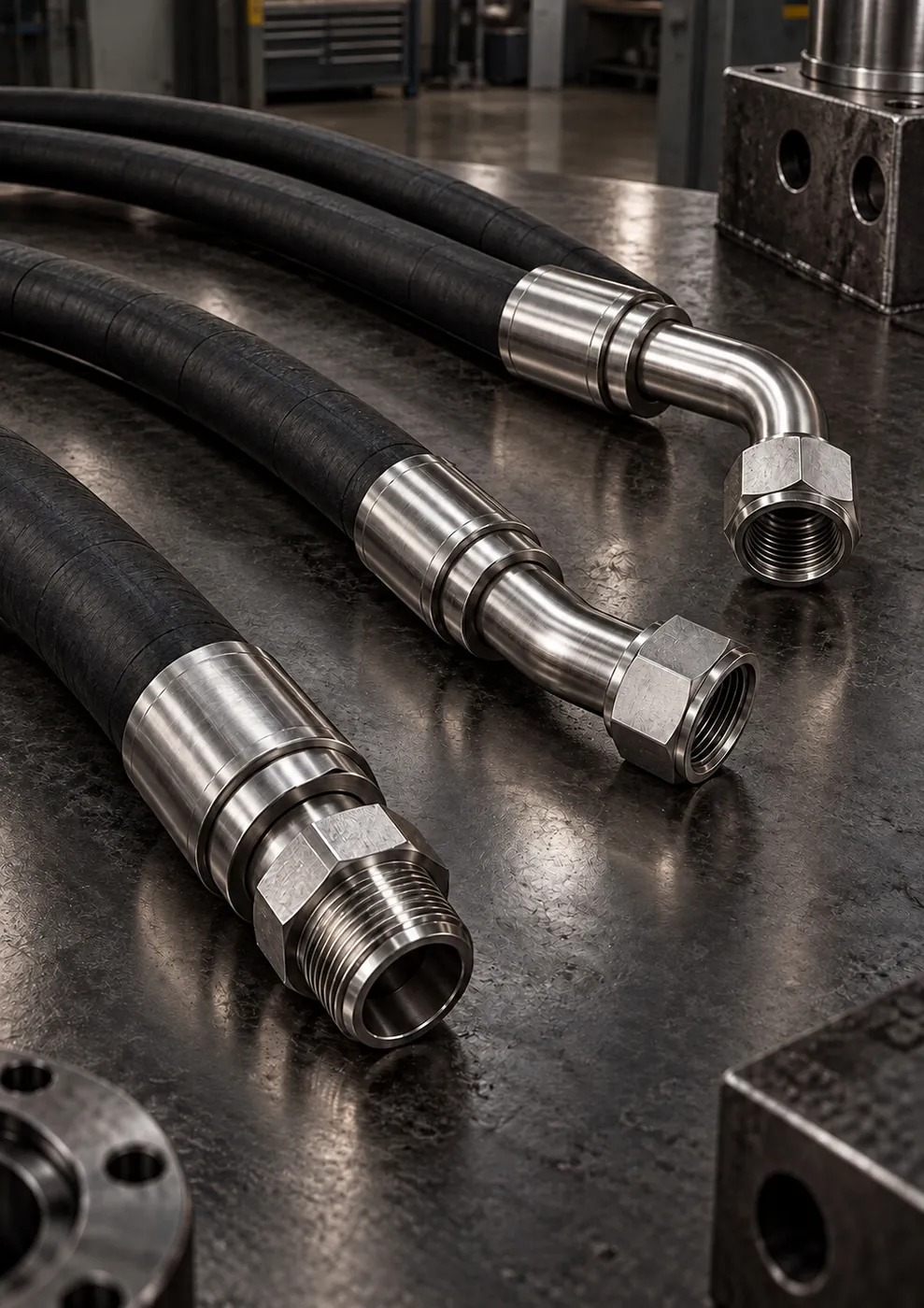
Stainless steel ends resist corrosion, but the hose itself is also affected by the outdoor environment. Sunlight and ozone gradually harden and crack the hose cover; saltwater entering through a crack in the cover starts corrosion in the reinforcement wires. For crane, hatch cover and steering hoses on open deck, the cover's resistance to outdoor exposure should be considered during selection, and hoses should be protected with a spiral guard or sleeve where needed. Hoses that rub against the structure or against each other as the ship moves should be separated with clamps, and the condition of the cover should also be checked during maintenance rounds.
Two types of corrosion that attack stainless steel
Pitting corrosion
Chloride ions break through the protective passive film of stainless steel at isolated points. A pit that looks small on the surface can widen beneath it and rapidly reduce wall thickness. This is why molybdenum-bearing 316/316L is preferred over 304 in marine applications. A smooth, clean surface also increases resistance: salt and moisture cling more easily to rough, scratched and dirty surfaces.
Crevice corrosion
Under seals, behind clamps, at thread roots, between overlapping surfaces and beneath deposits, oxygen cannot be replenished, and water trapped in these narrow areas becomes more aggressive over time. Crevice corrosion is dangerous because it cannot be seen from the outside: pits on the seal face or in the thread roots are only revealed when the connection is taken apart. Avoiding unnecessary crevices, choosing an installation orientation where water cannot collect, and regularly checking under clamps all reduce this risk.
Galvanic contact: the wrong neighbor means fast damage
When dissimilar metals are in contact in a conductive medium such as seawater, the less noble metal (the anode) corrodes rapidly. Stainless steel is on the noble side compared with many of the metals used at sea. Therefore:
- A carbon steel or galvanized adapter connected to stainless steel tubing rusts much faster than it would on its own.
- A stainless steel fitting connected directly to equipment with an aluminum body can start corrosion in the aluminum port.
- A small anode area combined with a large cathode area is the worst combination: a small carbon steel part attached to a large stainless steel surface is consumed very quickly.
If joining dissimilar metals is unavoidable, break the electrical contact with insulating gaskets and bushings, and include these points in the maintenance plan. The simplest solution is often to build the entire line in a single material family: 316/316L.
Watch out for iron contamination
Wire brushes, grinding discs or tools that have been used on carbon steel transfer iron particles to stainless steel surfaces. These particles soon rust, leaving brown stains on the surface, and can initiate pitting corrosion. For stainless steel installation work, use only brushes and tools reserved for stainless steel, and clean welded areas with an appropriate method.
Vibration and connection security
Vibration from the main engine, generators, pumps and propeller causes connections to loosen and tubes to develop fatigue cracks. When corrosion and vibration act together, damage accelerates.
- Install a hose assembly between the vibration source and the fixed line to keep movement from being transmitted to the connection.
- Support tubing with vibration clamps at adequate intervals; do not leave long runs unsupported.
- At points subject to vibration, O-ring face seal (ORFS) or O-ring boss port connections are more tolerant than metal-to-metal cone connections.
- During periodic maintenance, use witness marks drawn across the nut and body to check whether connections have shifted.
Maintenance access is part of the design
On a ship, how quickly a fitting can be replaced when something fails matters as much as its service life. A fitting in a cramped engine room where a wrench cannot turn makes a simple seal replacement a job that takes hours.
- Position removable connections so that there is enough room to swing a wrench.
- Install a valve and a removable connection upstream of frequently serviced equipment, so that the equipment can be disconnected without draining the line.
- Label lines and fittings; keep the number of thread standards on the same ship as low as possible.
During maintenance rounds, checking for oil traces around connections, rust stains (which may be a sign of iron contamination or galvanic contact), discoloration under clamps, cracks in hose covers and any shift in the witness marks on nuts helps catch small problems before they turn into failures.
Spare parts plan
For a ship at sea or an offshore installation, "the part will arrive tomorrow" is often not an option. Defining in advance the minimum spares to keep on hand for critical lines shortens downtime:
- List the fittings, adapters and flanges on critical lines, along with their thread standards and sizes.
- Record the length, end types and angle between the ends of hose assemblies that are replaced frequently.
- Keep O-ring and seal kits for each connection type in separate, labeled packs.
- Discuss stock and production lead times with your supplier in advance, based on the vessel's return-to-port schedule.
At GÜNEYSS, stock items are ready to ship within 1-3 business days on average; standard production is scheduled within 5-10 business days on average, made-to-length hose assemblies within 5-15 business days on average, and custom-size and project manufacturing within 10-20 business days on average after technical approval. When the spares list is shared in advance, no time is lost on technical verification when the order is placed.
Summary
- Treat 316L as the baseline in saline environments; also evaluate surface finish and geometry according to the area.
- Avoid details that create crevices and deposits.
- Do not join dissimilar metals directly; isolate them electrically if necessary.
- Keep vibration away from the connection, and support the line.
- Plan maintenance access and the spare parts list at the design stage.