


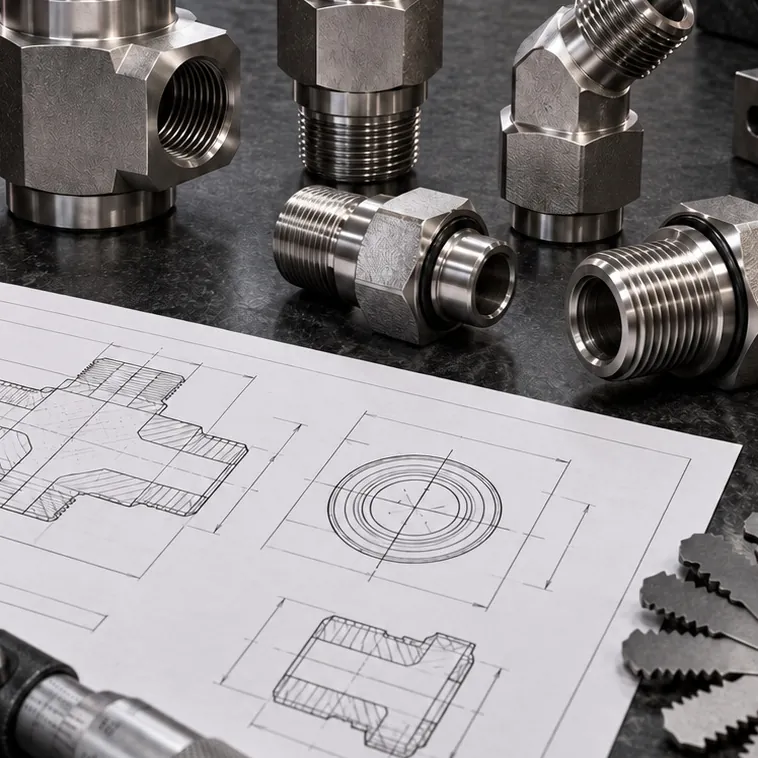
 Custom-Made Hydraulic Parts
Custom Hydraulic Adapter
Details & quote
Product group
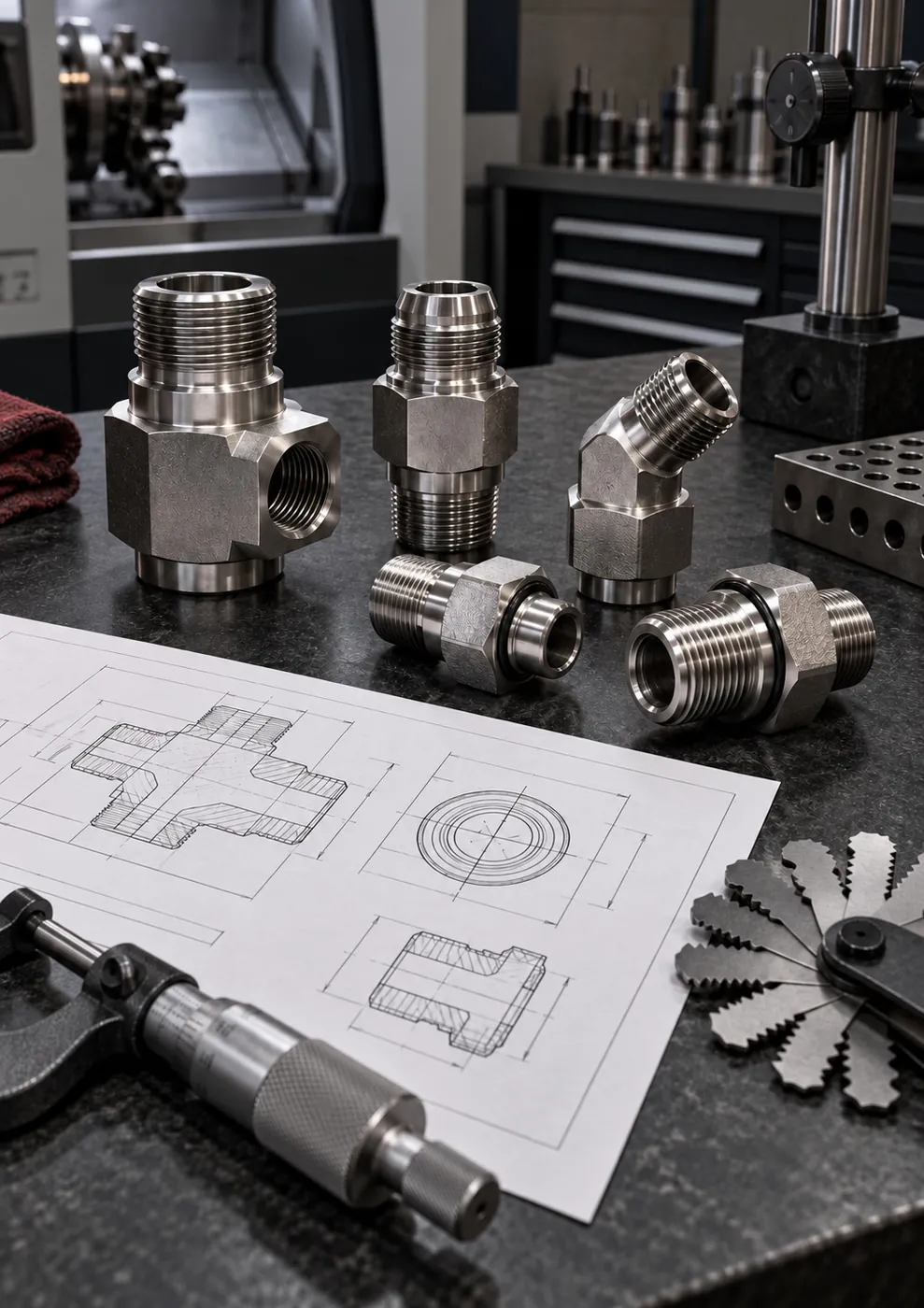
Custom adapters, nipples, flange blocks and transition parts made from samples or technical drawings; critical dimensions are confirmed in writing, and series production starts after first article approval.
 Custom-Made Hydraulic Parts
 Custom-Made Hydraulic Parts
Selection guide
Where standard products are not the answer, custom adapters, nipples, hydraulic manifolds, flange blocks and transition parts are produced from a sample, a technical drawing or dimensional data. Typical needs include a part for equipment that is no longer manufactured, an adapter that combines two different thread standards in a single body, an angled transition that must fit into a tight installation space, or a transition body that replaces several fittings and tubes with a single block. The parts are machined on CNC lathes from AISI 316/316L round and hex bar.
Critical diameters and tolerances, the thread designation of each port (such as G 1/2, 1/2-14 NPT, 3/4-16 UNF or M18x1.5), the shape and surface finish of the sealing surfaces, wrench flats, port orientations and installation clearances. The sealing surface and the thread are as decisive as the dimensions; when port size, connection direction and installation clearance are all clearly defined on the same drawing, production becomes more predictable.
When manufacturing from a worn sample, the original dimension is determined by comparing the amount of wear with the dimensions of the mating part. Indicating which surfaces of the sample wore during operation and which remained original speeds up this determination. For series quantities, dimensional variation between batches is prevented by checking the dimensions approved on the first article in every batch.
Custom-size and project manufacturing is typically scheduled within 10-20 business days after technical approval. A dimensional change made after approval shifts the schedule; that is why having the critical dimensions clearly defined from the start shortens the lead time.
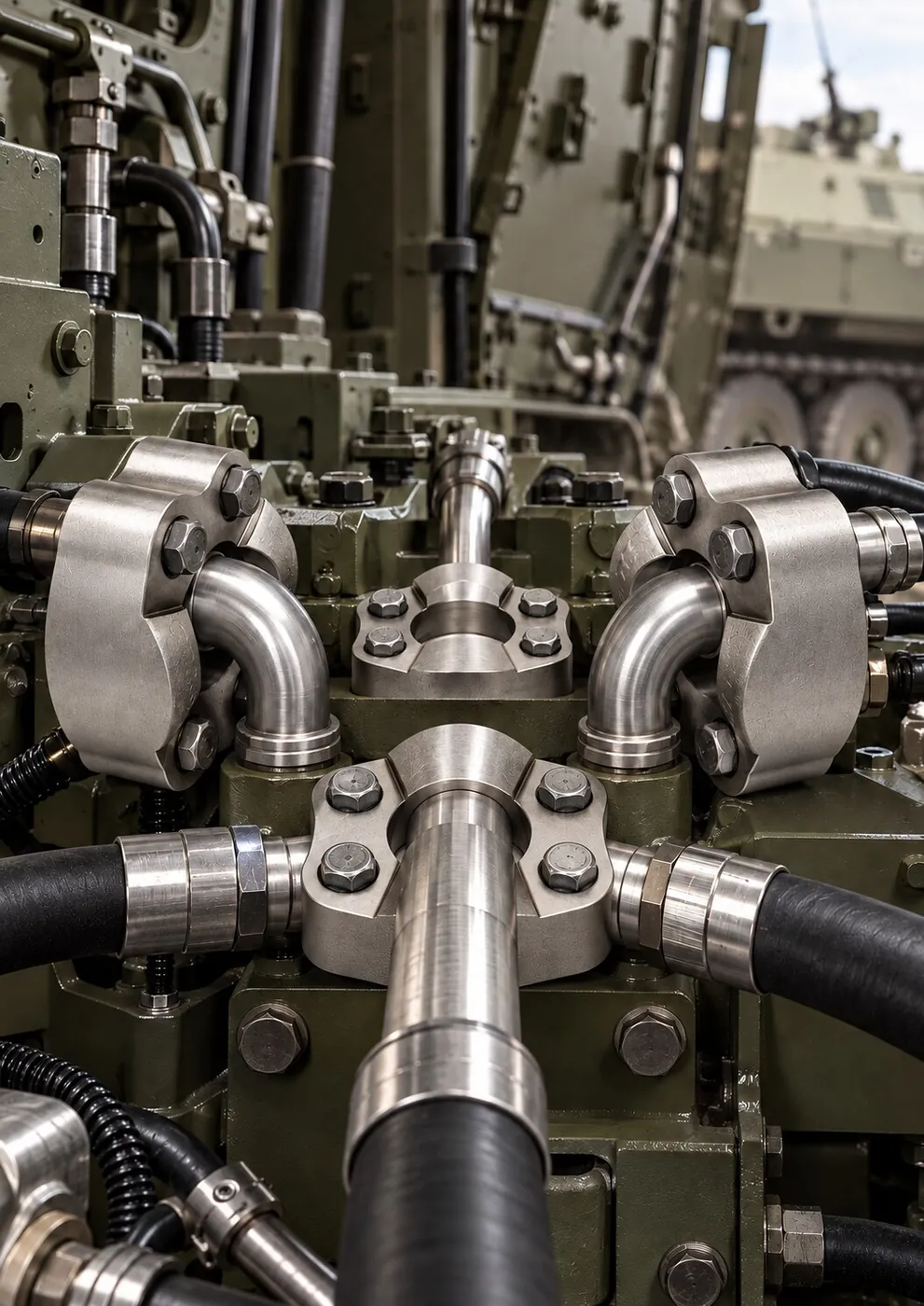
Flanges and transition parts produced to technical drawings in the defense industry, connections for ground support and test equipment in aviation, hard-to-find parts for foreign-made equipment on ships and in shipyards, spare parts for older machines in rolling mills and board mills, and non-standard port conversions in chemical plants.
Not sure about the right size?
Send the sample, the technical drawing or your caliper measurements, and we'll confirm the thread standard and the matching part together.
+90 545 206 13 74Knowledge Center
Technical articles on selecting, installing and maintaining the products in this group.
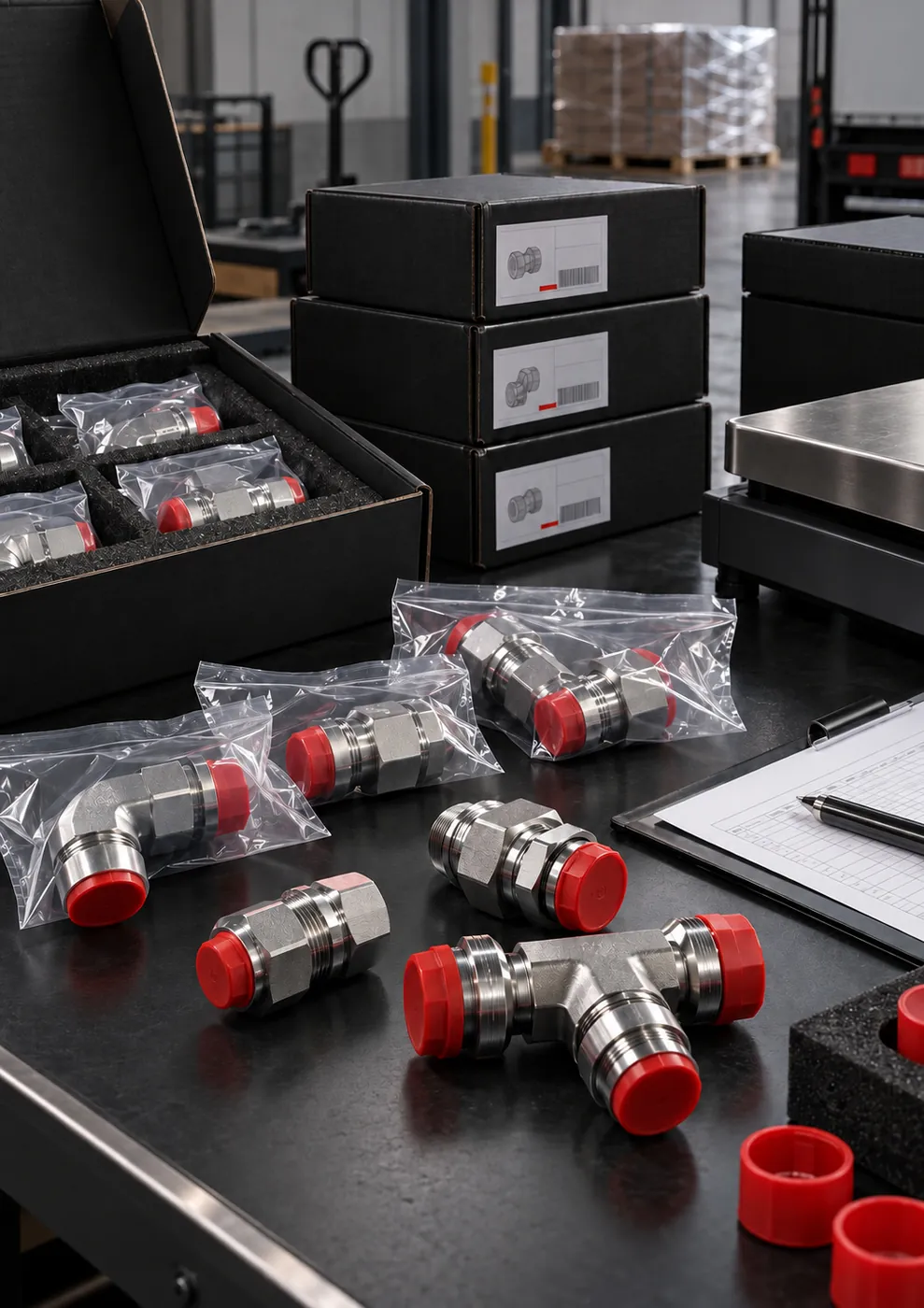
Stock items are prepared within an average of 1-3 business days, standard production within 5-10 business days, hose assemblies made to length within…
When a standard part won't fit, custom manufacturing starts with a sample, a dimensioned technical drawing or dimensional data. The thread standard…
FAQ
If your question isn't answered here, message us on WhatsApp with dimensions or a photo, and our technical team will answer directly.
Ask on WhatsAppAdapters and nipples in thread, size and angle combinations that have no equivalent in standard catalogs, flange blocks, manifold blocks that combine several lines in a single body, and stainless steel fittings for equipment that is no longer manufactured. Each request is evaluated for manufacturability based on a sample or technical drawing.
Critical diameters and tolerances, the thread designation of each port, the shape and surface finish of the sealing surfaces, wrench flats, port orientations and installation clearances. The material (316 or 316L), quantity and operating conditions should also be stated on the drawing or in the request.
If the part will be welded, low-carbon 316L is preferred, as it reduces the risk of intergranular corrosion after welding. For parts that are only machined and not welded, 316 can also be used. The choice is confirmed together with the fluid, temperature and environmental conditions.
A change in a dimension or standard after technical approval requires reconfirmation and shifts the production schedule; if machining has already started, the part may have to be machined again. That is why critical dimensions, the thread standard and the sealing type are finalized in writing before production.