


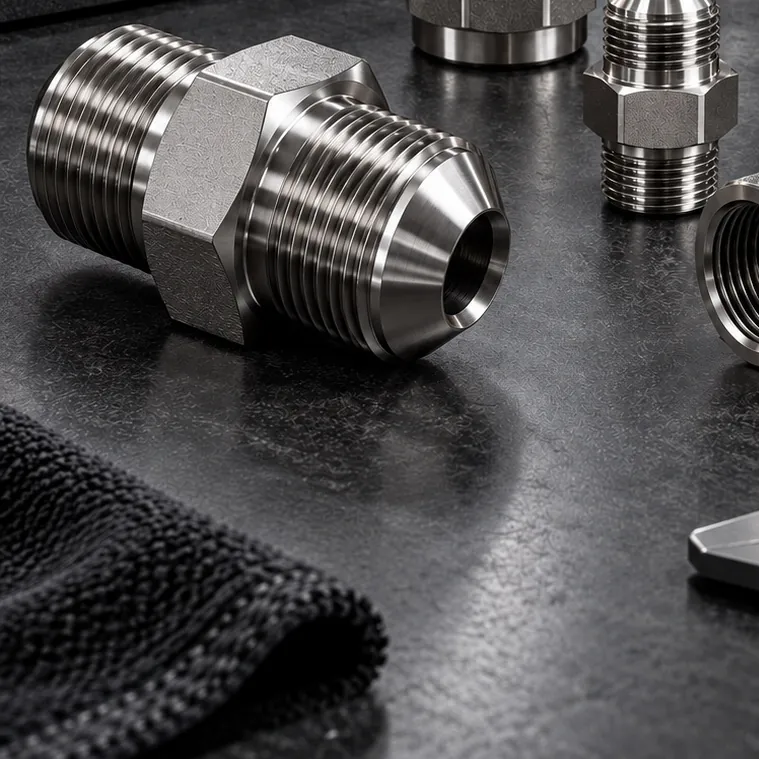
 JIC 37° Fittings & Adapters
JIC Male x JIC Male Adapter
Details & quote
Stainless Steel Hydraulic Fittings
UNF-threaded adapters, fittings, plugs and caps with JIC 37° flare seats; options with BSP and NPT conversions.
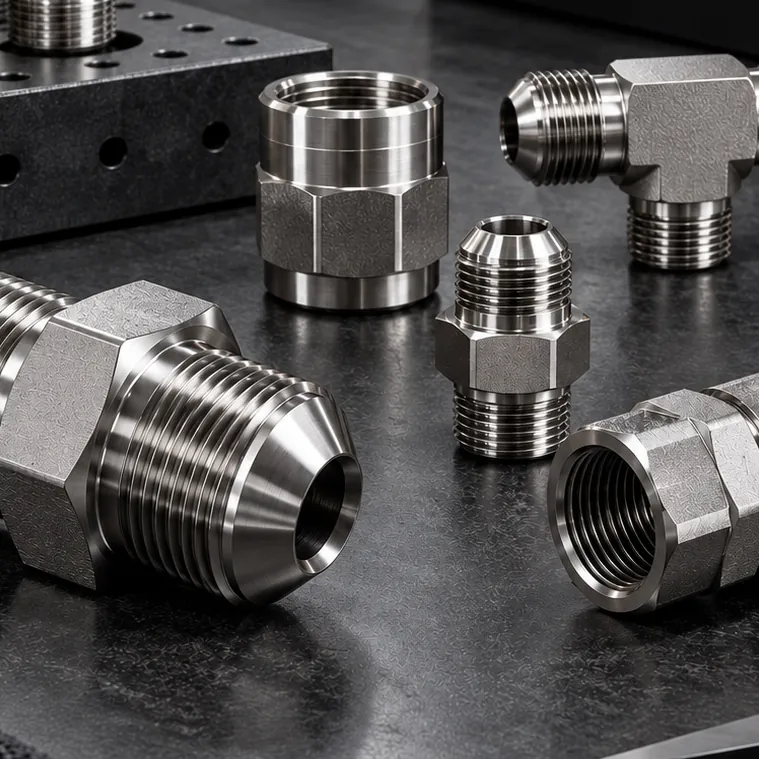 JIC 37° Fittings & Adapters JIC 37° Fittings & Adapters
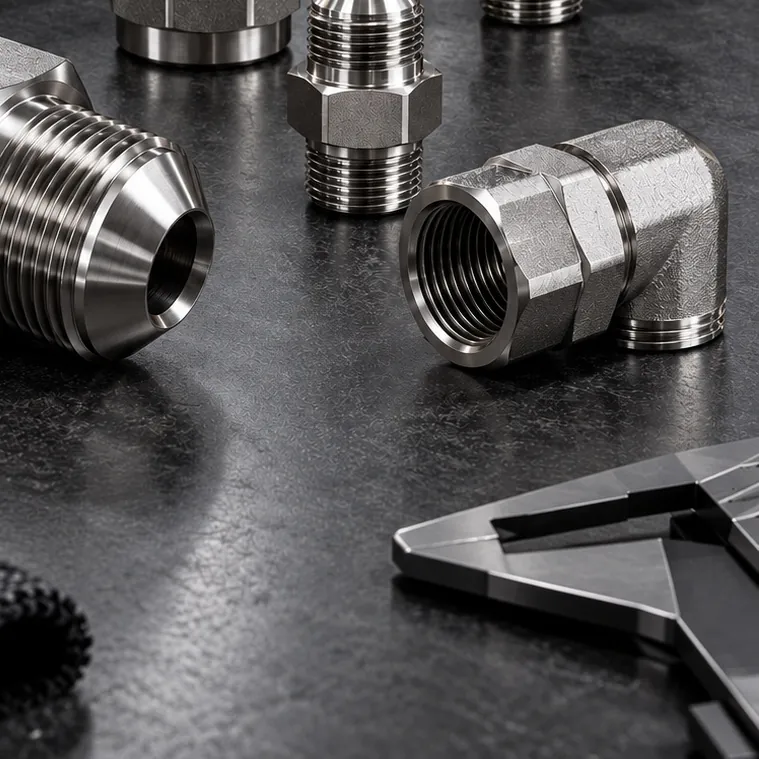 JIC 37° Fittings & Adapters JIC 37° Fittings & Adapters
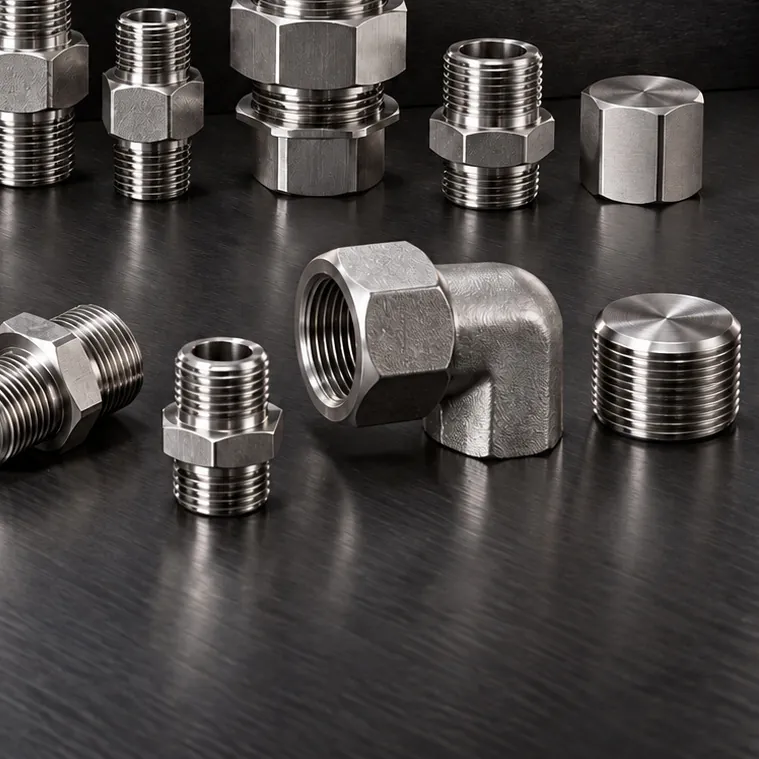 JIC 37° Fittings & Adapters JIC 37° Fittings & Adapters
Selection guide
In JIC 37° connections, sealing is achieved by the 37° conical surfaces of the male and female parts seating against each other; the UNF thread only holds the parts together. This connection type is defined in SAE J514 and ISO 8434-2. It is widely used on machines built to American standards, in mobile hydraulics, and in aviation ground support and test equipment. The parts searched for in the field as "JIC fittings" or 37° flare fittings are in this group.
JIC sizes are usually referred to by their "dash" number. The dash number gives the tube OD in sixteenths of an inch: -8 means 8/16, i.e. 1/2 inch tube. The threads for common sizes are as follows:
| Dash | Tube OD | Thread |
|---|---|---|
| -4 | 1/4 inch | 7/16-20 UNF |
| -6 | 3/8 inch | 9/16-18 UNF |
| -8 | 1/2 inch | 3/4-16 UNF |
| -10 | 5/8 inch | 7/8-14 UNF |
| -12 | 3/4 inch | 1 1/16-12 UN |
| -16 | 1 inch | 1 5/16-12 UN |
The conical surface must be clean and free of scratches; no sealing tape or liquid sealant is applied to JIC threads or cones. Tightening is done to the table torque or by the flats-from-wrench-resistance method (FFWR), turning a specified number of hex flats past the hand-tight position. Overtightening crushes the cone and causes a leak at the next assembly; a connection forced into place with misalignment also loosens under vibration. To prevent galling on stainless-to-stainless threads, keep the threads clean and use a suitable anti-seize compound where necessary.
Mobile hydraulics and compact power units in the defense industry, ground support and hydraulic test equipment in aviation, American-made deck machinery and cranes, and the hydraulic circuits of imported machines in rolling mills and board mills. Stainless steel JIC fittings are preferred where carbon steel equivalents of the same size rust in salty, humid environments.
Not sure about the right size?
Send the sample, the technical drawing or your caliper measurements, and we'll confirm the thread standard and the matching part together.
+90 545 206 13 74Knowledge Center
Technical articles on selecting, installing and maintaining the products in this group.
Hydraulic connections are sealed in four ways: O-ring, bonded seal (Dowty washer), metal cone face and tapered thread. On parallel threads, the seal…
BSP threads have a 55° profile, while NPT, UNF and metric threads have a 60° profile. BSPT and NPT tapered threads seal on the thread itself; on…
FAQ
If your question isn't answered here, message us on WhatsApp with dimensions or a photo, and our technical team will answer directly.
Ask on WhatsAppSealing is achieved by metal-to-metal contact between the 37° conical surfaces of the male and female parts; the UNF thread only holds the parts together. That is why tape or liquid sealant wrapped on the threads does nothing for sealing; it can carry particles into the hydraulic system and throw off correct tightening.
The dash number indicates the tube OD in sixteenths of an inch: -6 corresponds to 3/8 inch, -8 to 1/2 inch and -12 to 3/4 inch tube. The thread size also follows from this number; for example, a -8 JIC thread is 3/4-16 UNF.
Usually not. UNF-threaded pump and valve ports are mostly O-ring boss ports (ISO 11926 / SAE J1926); they take a port adapter with an O-ring port thread on one end and a JIC 37° male on the other. Check whether the mouth of the port has an O-ring chamfer.
Either to the torque value in the table or by the flats-from-wrench-resistance (FFWR) method, turning the nut a specified number of hex flats past the hand-tight position. Because the conical surfaces seat metal-to-metal, overtightening crushes the cone, and a crushed cone leaks at the next assembly. Before tightening, check that the hose or tube is aligned and not under strain.
The most common causes are a scratched or crushed conical surface, overtightening, mating with the wrong cone angle (45° vs. 37°), and a connection forced into place with misalignment. Check the cone of the leaking part; a damaged cone cannot be fixed by tightening, and the part must be replaced.