


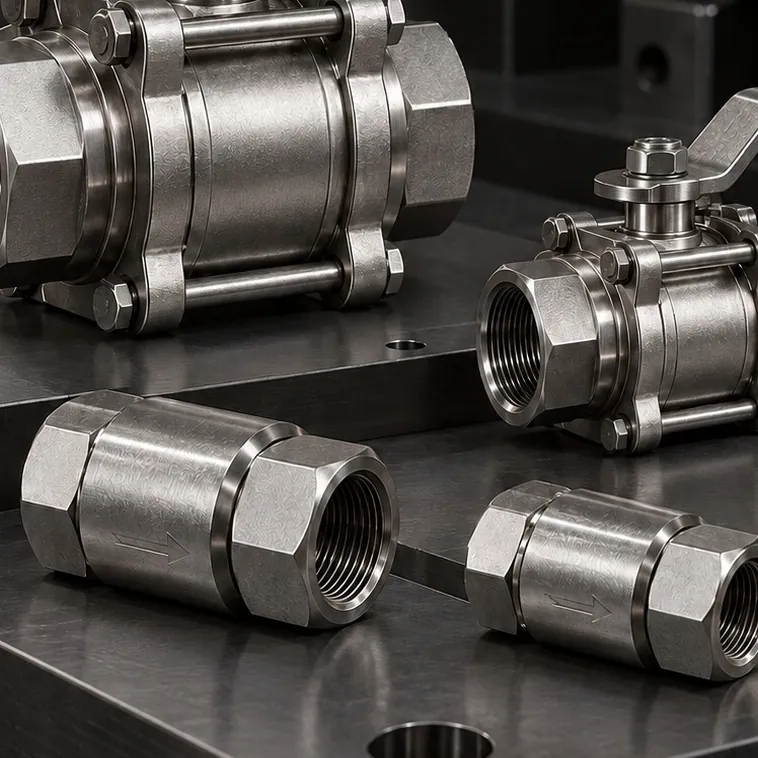
 Ball, Needle & Check Valves
High-Pressure Stainless Ball Valve
Details & quote
Product group
Stainless steel ball valves, high-pressure needle valves and check valves; BSP/NPT and project-specific connection options.
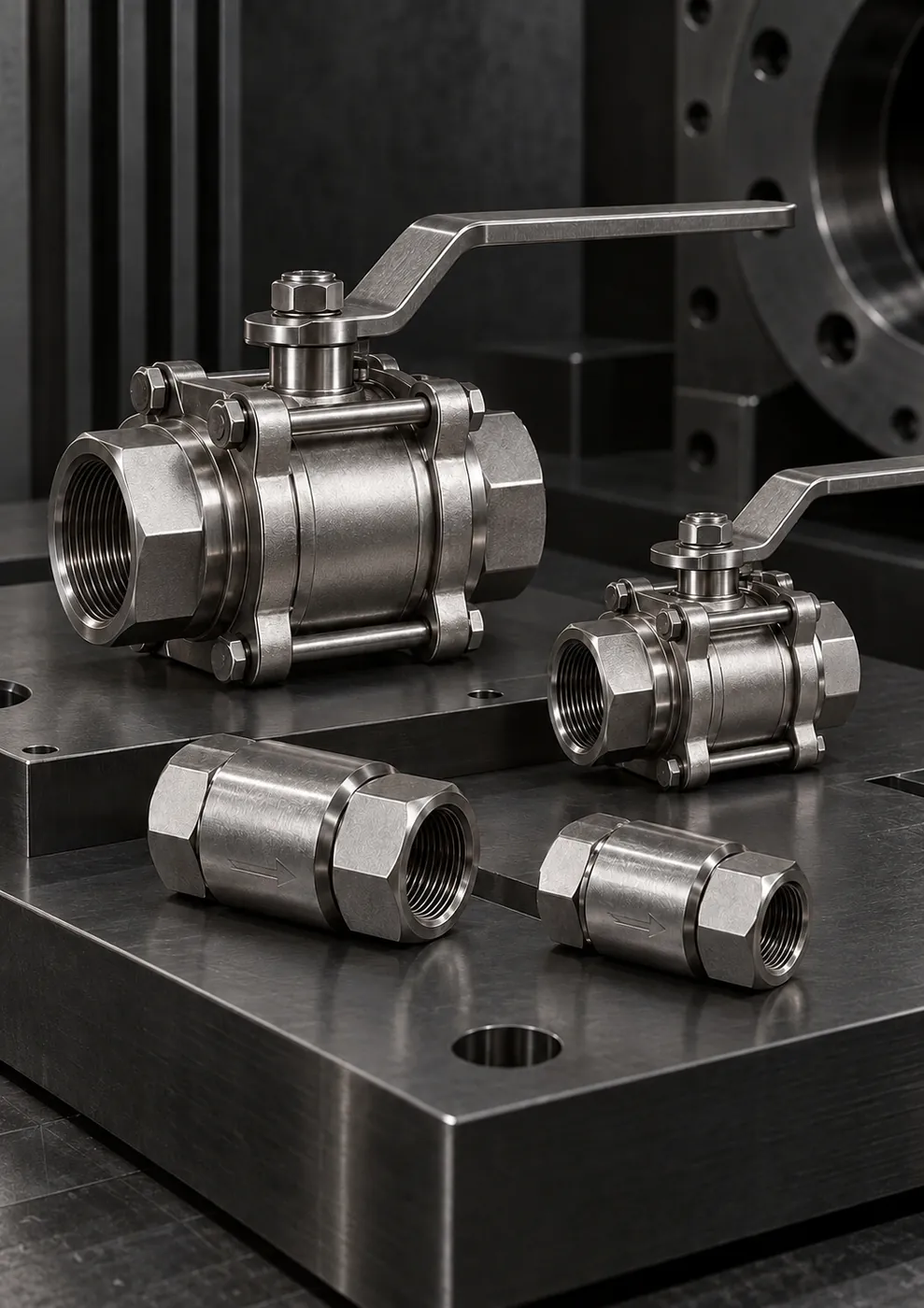 Ball, Needle & Check Valves Ball, Needle & Check Valves
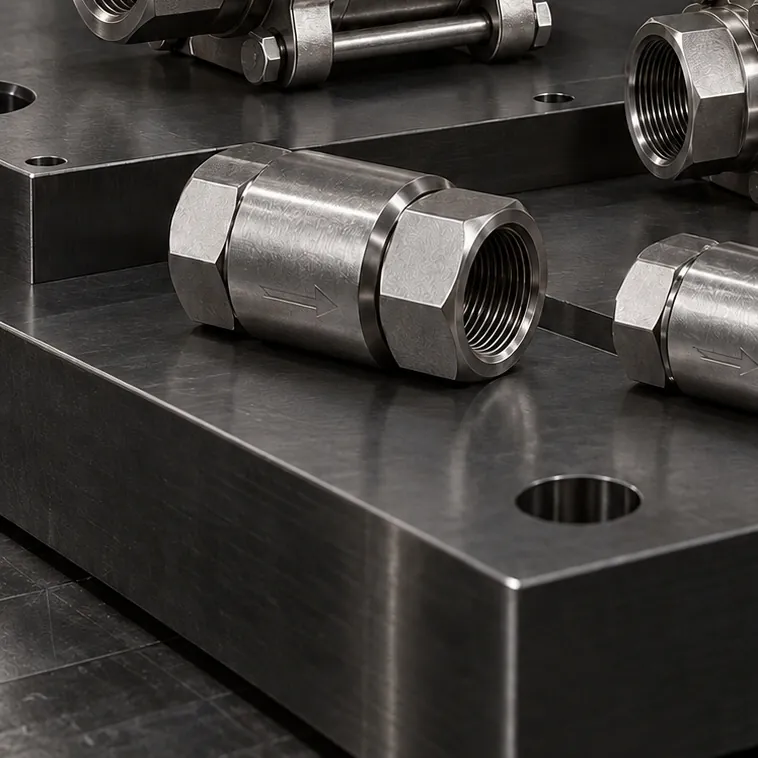 Ball, Needle & Check Valves
Selection guide
Stainless steel ball valves are used for quick on/off shutoff on a line, needle valves for fine flow adjustment and isolation of measurement lines, and check valves to keep flow moving in one direction. This group includes valves with AISI 316L bodies, offered with BSP, NPT and project-specific connection options. Body material, connection standard, bore size, working pressure, temperature and fluid compatibility should be evaluated together during selection.
| Valve | How it works | Typical use |
|---|---|---|
| Ball valve | A ported ball rotates a quarter turn; operates fully open or fully closed | Line isolation, isolation for maintenance, draining |
| Needle valve | Flow is throttled progressively as the tapered stem approaches its seat | Pressure gauge isolation, sampling and control lines, fine flow adjustment |
| Check valve (non-return valve) | A spring-loaded poppet opens in the flow direction and closes on reverse flow | Pump discharge, transfer and dosing lines |
Install the check valve according to the flow arrow on its body; a check valve installed backwards shuts off the line completely. Do not use a ball valve half-open to control flow: throttling quickly wears the seat surfaces, and the valve starts leaking when closed. Do not overtighten a needle valve; the tapered stem and seat will be crushed. Choose a layout where the valve handle will not hit adjacent components in the open position and remains accessible for service; the valve must not carry the weight of the line, and the pipe must be supported. On welded lines, the line must be cleaned before the valve is installed so that weld spatter and chips do not get inside the valve.
Process and transfer lines in chemical plants, cleanable stainless steel lines in food and beverage plants, check valve and isolation points on fire pump sets, lines exposed to salty environments on offshore and marine systems, and test and control lines in defense and aviation. For the correct placement of valves in the line and the design of flow control, see also our valves and flow control service page. For valves whose end connections and body type vary by request (especially needle valves), the type and lead time are confirmed in the quote.
Not sure about the right size?
Send the sample, the technical drawing or your caliper measurements, and we'll confirm the thread standard and the matching part together.
+90 545 206 13 74Knowledge Center
Technical articles on selecting, installing and maintaining the products in this group.
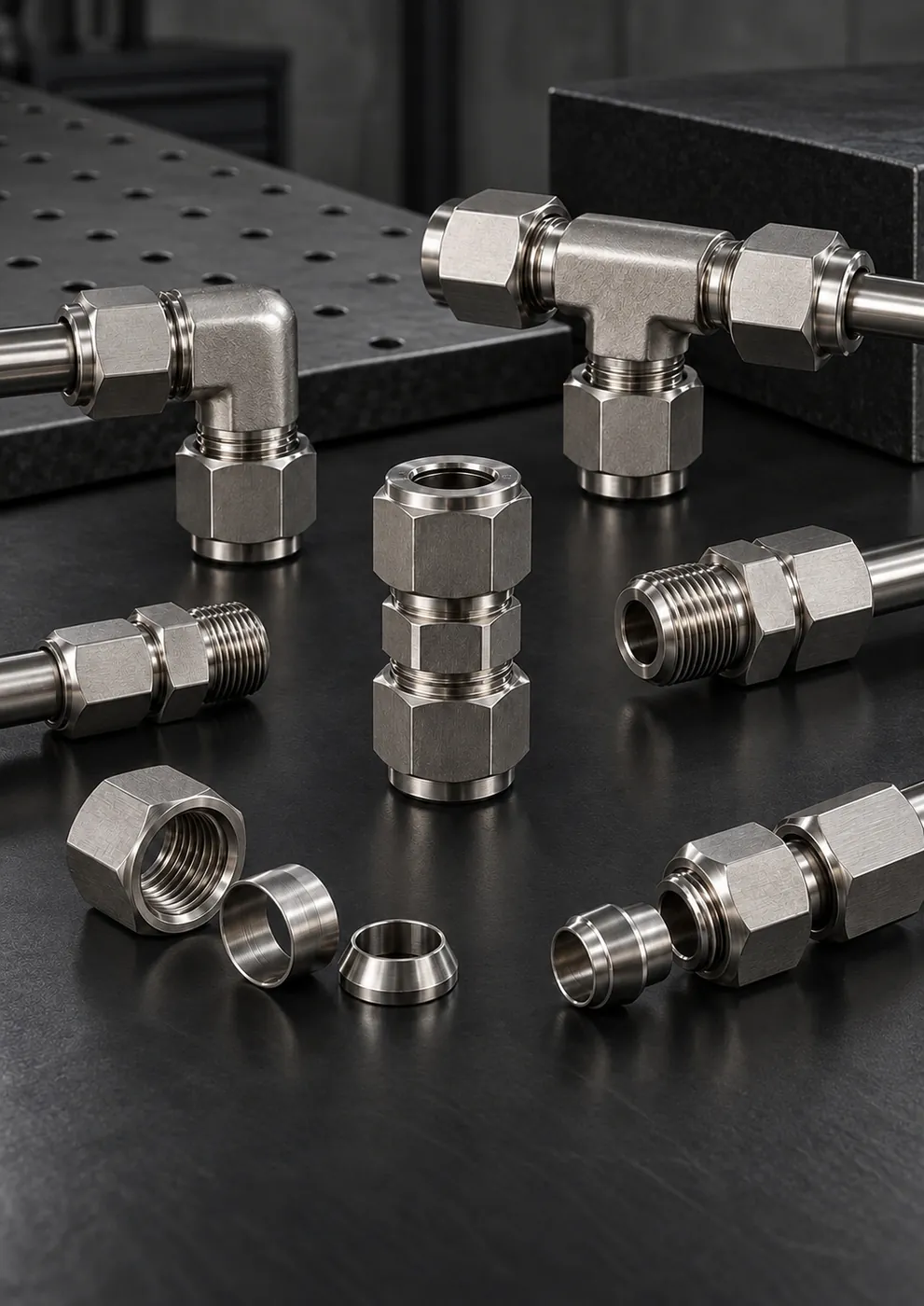
In a twin-ferrule fitting, the front ferrule provides the seal and the back ferrule grips the tube. For correct installation, the tube is cut square…
In saltwater environments, the baseline material is AISI 316L; its molybdenum content increases resistance to chloride-induced pitting and crevice…
FAQ
If your question isn't answered here, message us on WhatsApp with dimensions or a photo, and our technical team will answer directly.
Ask on WhatsAppIn a full-bore valve, the ball bore is close to the pipe ID; pressure loss is at its lowest and the line is easier to clean. A reduced-bore valve is more compact and lighter; it is sufficient at isolation points where pressure loss is not critical. The choice depends on flow rate, pressure loss tolerance and installation space.
Cracking pressure is the inlet-to-outlet pressure differential required to open the check valve poppet against its spring. A low cracking pressure offers little resistance to flow; a high cracking pressure is chosen to hold the line at a certain pressure or to prevent unwanted flow. The value is set by spring selection.
Even if the body is 316L, the valve will soon leak if the seat, seal and packing materials in contact with the fluid are not compatible. These parts are selected according to the type, concentration and temperature of the fluid. Sharing the fluid details in your quote request ensures that the right internal materials are selected.
In ball valves, the most common cause is using the valve half-open for throttling, which wears the seat surfaces. Weld spatter or chips left in the line can also score the seat. In needle valves, overtightening crushes the stem and seat. In check valves, dirt trapped between the poppet and the seat prevents closing.
The check valve must be installed according to its flow arrow, the ball valve handle must be able to turn freely for full opening and closing, the valve must not carry the weight of the line, and the pipe must be supported. Access should be left in front of and behind valves that will be removed during maintenance, and a detachable connection point should be planned if necessary.