Marine & Shipping · Technical guide
BSP, NPT, UNF/JIC and Metric Threads: How to Identify and Match Them
Quick answer
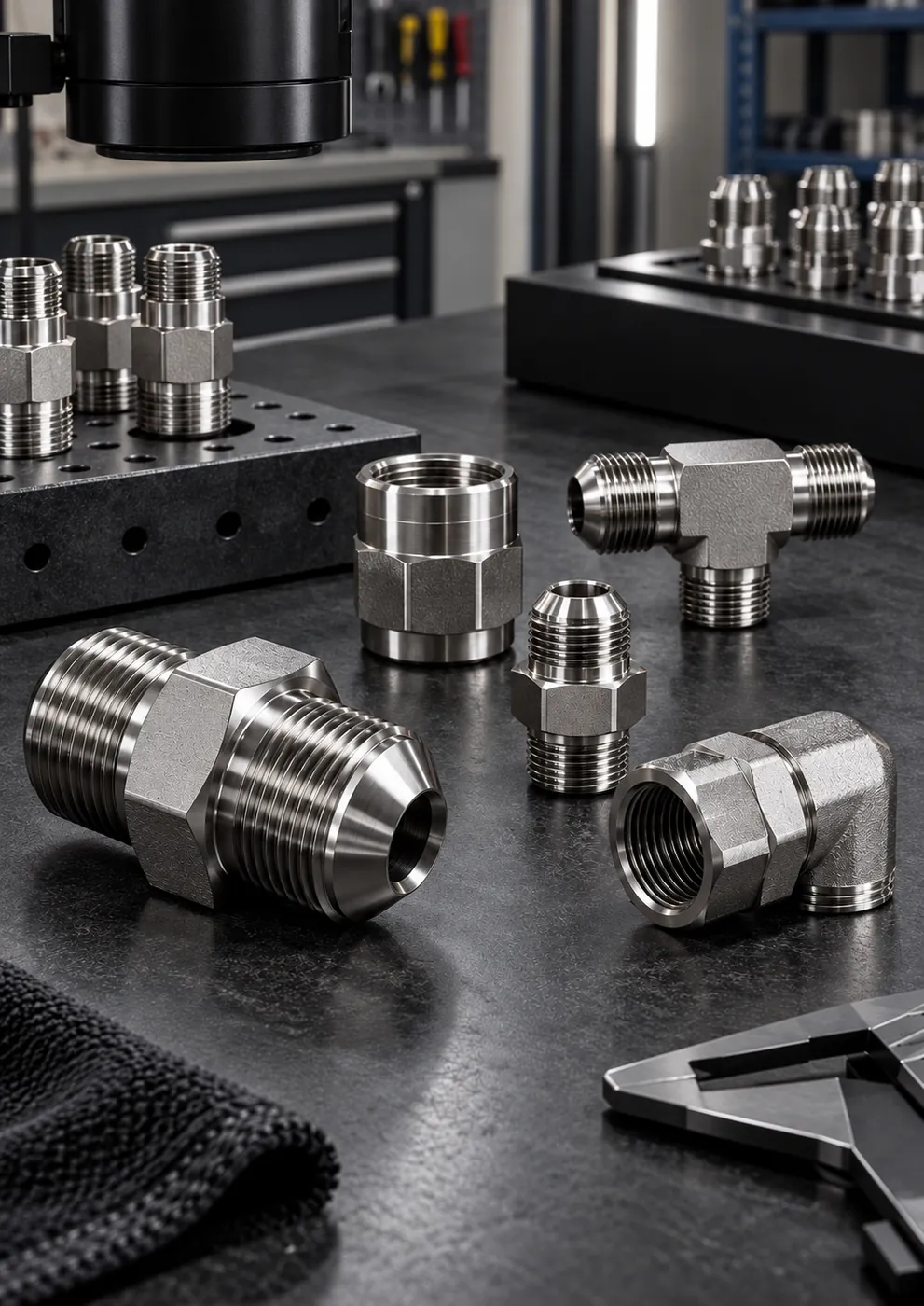
BSP threads have a 55° profile, while NPT, UNF and metric threads have a 60° profile. BSPT and NPT tapered threads seal on the thread itself; on BSPP, UNF and metric parallel threads, sealing is provided by a seal, an O-ring or a cone face. That is why threads that look alike are not interchangeable: to get the correct match, measure the diameter with a caliper and the pitch with a thread pitch gauge, and check the sealing surface at the same time.
A significant share of leaks in hydraulic lines is caused not by the wrong material but by a mismatched thread. BSP, NPT, UNF and metric threads look very similar at first glance; in some sizes, a male fitting will run a few turns into the wrong port quite easily and then bind. In this article we cover the four thread families you will encounter most often in the field, where each one seals, and which measurements you can use to confirm the correct match.
Four thread families, four different principles
Three basic characteristics set thread standards apart: the thread profile angle, whether the thread is parallel or tapered, and where the seal is made. Outside diameter and pitch are only part of the picture.
BSP: 55° Whitworth profile
In the BSP (British Standard Pipe) family, the thread profile is 55°, with rounded crests and roots. There are two types. BSPP is a parallel thread (G designation, ISO 228-1) and does not seal on the thread; sealing is provided by a bonded seal (a metal washer with a bonded rubber seal), an O-ring, or the 60° cone seat commonly found on hose ends. BSPT is cut with a 1:16 taper (R male, Rc female designation, ISO 7-1) and seals on the thread, with a suitable thread sealant.
NPT: 60° profile, 1:16 taper
NPT (ASME B1.20.1) is the American pipe thread. The profile angle is 60° and the taper is 1:16; crests and roots are flat. Sealing is achieved as the tapered threads wedge into one another during tightening, together with the sealant applied to the threads. Because tapered threads seal by partially deforming as they are tightened, they are not ideal for connections that are frequently taken apart and reassembled.
UNF and JIC: parallel thread, separate sealing surface
UNF (Unified National Fine) is a 60°, parallel, fine-pitch thread. In hydraulics, a UNF thread does not seal on its own; the connection type it is used with determines how the seal is made. In JIC connections (SAE J514, ISO 8434-2), sealing is by metal-to-metal contact between 37° cone surfaces; in ORFS connections (SAE J1453, ISO 8434-3), by an O-ring on the face; and in O-ring boss ports (SAE J1926, ISO 11926), by the O-ring on the hex side of the male fitting being compressed into the chamfer at the port opening. The 37° JIC cone should not be confused with the 45° SAE flare connection found in refrigeration and low-pressure lines.
Metric threads: 60° profile, pitch in millimeters
Metric threads (ISO 261) have a 60° profile, and the pitch is specified in millimeters, e.g., M18x1.5. In hydraulics, their most common use is in 24° cone ferrule fittings covered by DIN 2353 / ISO 8434-1; in the field these are usually called "Ermeto-type fittings" (the name comes from a manufacturer's registered trademark). Here, too, the thread does not seal; the seal is made between the 24° cone and the ferrule or an O-ring cone end. In ISO 6149 metric ports, sealing is provided by an O-ring. For the same tube OD, the nut threads differ between the light (L) and heavy (S) series: for 12 mm tube, the L series uses M18x1.5 and the S series uses M20x1.5.
Comparison table
| Standard | Profile angle | Thread form | Where is the seal? | Typical designation |
|---|---|---|---|---|
| BSPP | 55° | Parallel | Bonded seal, O-ring or 60° cone | G 1/2 |
| BSPT | 55° | Tapered (1:16) | On the thread, with sealant | R 1/2, Rc 1/2 |
| NPT | 60° | Tapered (1:16) | On the thread, with sealant | 1/2-14 NPT |
| UNF / JIC | 60° | Parallel | 37° cone (JIC), O-ring (ORFS, O-ring boss port) | 3/4-16 UNF |
| Metric | 60° | Parallel | 24° cone and ferrule, O-ring | M18x1.5 |
Why a caliper alone is not enough
The nominal size is not the actual outside diameter of the thread. For example, a 1/2" BSP male thread has an OD of approximately 20.96 mm; the "half inch" designation comes from pipe sizing convention. More importantly, outside diameters in different standards can be very close to one another. A caliper gives you an approximate diameter; it does not tell you the angle, the pitch or the taper.
The most typical trap is in the 1/2" and 3/4" sizes: in these two sizes, both BSP and NPT have 14 threads per inch. A BSP male fitting will run a few turns into an NPT female port with ease; the difference between the 55° and 60° profiles only shows up during tightening. In other sizes, the pitches are close but different:
| Nominal size | BSP (threads per inch) | NPT (threads per inch) |
|---|---|---|
| 1/8" | 28 | 27 |
| 1/4" | 19 | 18 |
| 3/8" | 19 | 18 |
| 1/2" | 14 | 14 |
| 3/4" | 14 | 14 |
| 1" | 11 | 11.5 |
Step-by-step measurement for correct identification
- Diameter: With a caliper, measure the outside diameter on a male part and the inside diameter on a female part, across the thread crests. On a tapered thread, the diameter differs between the first and last threads; on a parallel thread, it is constant.
- Pitch: Hold the thread pitch gauge up to the light; the gauge that seats with no gaps is the correct pitch. Try inch and metric gauges separately.
- Profile angle: With close pitches, both the 55° and 60° gauges may appear to seat. Slide the gauge along several threads and check for gaps at the crests and roots.
- Sealing surface: Check whether the part has a 37° or 24° cone, an O-ring groove, a flat face or a seal seating surface. The cone angle is just as decisive as the thread.
- Mating part: Also record a photo and the dimensions of the port or hose end it will connect to. The chamfer, countersink and face shape on the port side often give away the standard.
If you are still unsure after measuring, send a clear photo of the part taken next to the caliper, or send us the sample. Once the thread standard and sealing type have been confirmed, we recommend the correct part.
Consequences of forcing a mismatched thread
- Leakage: Different profile angles prevent full contact between the thread flanks; on a tapered thread, the sealant cannot close the gap, and on a parallel thread, the seal does not compress properly.
- Permanent thread damage: Damaging the thread in a pump housing, valve block or cylinder port turns a simple adapter mistake into an expensive housing repair.
- Galling: Forcing stainless steel threads can cause the surfaces to cold-weld to each other; the part often has to be cut off to be removed.
- Safety risk: A connection engaged on only a few threads can loosen and blow out under pressure or vibration.
If a connection runs in freely for a few turns and then suddenly tightens, stop. Tightening it "just a bit more" with a wrench will not solve the problem; recheck the standard.
When different standards have to be connected
A British-standard pump and an American-standard valve on the same line is a common situation aboard a ship. For such transitions, the solution is an adapter with each end machined to a different standard: for example, BSPP male on one side and JIC male on the other. When selecting an adapter, consider the pressure rating, sealing type and installation orientation of both ends together. Transitions with no catalog equivalent can be custom machined on CNC machines from a technical drawing or sample.
Checklist
- Did you measure the diameter with a caliper and the pitch with a thread pitch gauge?
- Did you check at the first and last threads whether the thread is parallel or tapered?
- Did you identify the sealing surface (cone angle, O-ring groove, seal face)?
- Is the standard of the mating part known?
- If a transition between different standards is required, has a suitable adapter been specified?
- If you are unsure, did you request verification with a photo or sample?