Marine & Shipping · Technical guide
AISI 316 vs 316L: Differences and the Right Choice for Hydraulic Fittings
Quick answer
The only difference between 316 and 316L is the carbon limit: max. 0.08% for 316 and max. 0.03% for 316L. Because low carbon reduces the risk of intergranular corrosion after welding, 316L is the choice for welded parts. Thanks to 2-3% molybdenum, both are markedly more resistant than 304 in chloride environments; titanium-stabilized 316Ti (1.4571) is preferred for parts that remain at sensitization temperatures for extended periods.
Material selection for stainless steel hydraulic fittings is often made with the mindset that "as long as it's stainless, it will do." Yet when saltwater, chloride-containing cleaning chemicals or welded joints are involved, the difference between 304, 316 and 316L directly determines the service life of the fitting. In this article we compare the three grades in terms of chemical composition, corrosion behavior and weldability, and explain which one makes sense in which application.
Three grades, one table
The values below are composition limits from widely used material standards such as ASTM A240 and A276 (percent by weight). Minor differences may apply depending on the product form and standard.
| Property | 304 | 316 | 316L |
|---|---|---|---|
| Carbon (max.) | 0.08% | 0.08% | 0.03% |
| Chromium | 18-20% | 16-18% | 16-18% |
| Nickel | 8-10.5% | 10-14% | 10-14% |
| Molybdenum | None | 2-3% | 2-3% |
| Chloride environment | Limited | Good | Good |
| Intergranular corrosion after welding | Risk depends on heat input | Risk depends on heat input | Low risk |
The role of molybdenum: resistance to chlorides
What protects stainless steel is a very thin chromium oxide layer that forms spontaneously on the surface (the passive film). Chloride ions can break down this film locally. The result is pitting corrosion, which starts as pinpoint-sized spots on the surface and progresses deeper, and crevice corrosion, which develops in narrow gaps such as under seals or clamps.
The 2-3 percent molybdenum in the 316 family increases the passive film's resistance to chlorides. This is why the PREN value used to compare pitting resistance (%Cr + 3.3 × %Mo + 16 × %N) is markedly higher for 316 than for 304. It is also the main reason 316/316L is preferred in environments involving seawater spray, salt air, and chlorinated cleaning and disinfection chemicals.
The only difference between 316 and 316L: carbon
316 and 316L have the same chromium, nickel and molybdenum ranges. The difference lies in the carbon limit: max. 0.08 percent for 316 and max. 0.03 percent for 316L (L for low carbon).
This small difference matters a great deal in welding. If stainless steel stays long enough within a certain temperature range during welding (approximately 450-850 °C), carbon combines with chromium at the grain boundaries to form chromium carbides. The area around the grain boundary becomes depleted in chromium and is left unprotected against corrosion. This condition is called sensitization, and the damage that follows is called intergranular corrosion. It typically appears as a band right next to the weld, in the heat-affected zone.
Because the low carbon content of 316L limits the carbon available for carbide formation, it significantly reduces the risk of intergranular corrosion after welding. For welded nipples, pipe-to-flange joints and any part welded into a pipeline, 316L is the right starting point.
Strength and machinability
Low carbon slightly lowers the yield strength of 316L compared with 316. This is why dual-certified "316/316L" raw material, which meets the requirements of both grades, is common on the market. In CNC machining there is no significant difference between the two grades; like all austenitic stainless steels, both tend to work-harden during machining. Sharp tooling, correct cutting parameters and adequate coolant are essential for a clean thread finish and a smooth sealing surface.
Another characteristic of stainless steel threads is their susceptibility to galling. When a stainless steel male fitting is installed in a stainless steel female port, clean threads and a suitable anti-seize compound reduce this risk significantly.
316L or 316Ti (1.4571)?
In Europe, particularly in DIN-based hydraulic fitting series, the stainless steel grade most often encountered is 1.4571, whose AISI equivalent is 316Ti. This number also appears frequently on supply lists and drawings in Türkiye. 316Ti has the same chromium, nickel and molybdenum ranges as 316; the difference is the titanium added to its composition.
Titanium binds carbon before chromium can, forming titanium carbides. As a result, carbon cannot form chromium carbides, and chromium depletion at the grain boundaries is prevented; this method is called stabilization. 316L solves the same problem by reducing carbon, whereas 316Ti solves it by tying up the carbon with titanium. Both grades are protected against intergranular corrosion after welding, and their general corrosion resistance at room temperature is very similar.
| Grade | EN number | Carbon (max.) | Protection against sensitization |
|---|---|---|---|
| 316 | 1.4401 | 0.08% | None |
| 316L | 1.4404 | 0.03% | Low carbon |
| 316Ti | 1.4571 | 0.08% | Titanium stabilization (Ti min. 5 × (C+N), max. 0.70%) |
Carbon limits are ASTM values; EN 10088 specifies slightly different limits for some grades.
The difference becomes significant at high temperatures. If a part will remain in the sensitization range (approximately 450-850 °C) for a long time, for example when thick-section welded parts cool slowly or when a part operates close to these temperatures for extended periods, low carbon alone may eventually prove insufficient; in such cases, the stabilized structure of 316Ti is considered the safer option. On the other hand, titanium carbide particles can leave marks on surfaces that require a mirror polish; for this reason, 316L is generally preferred in food and pharmaceutical facilities where hygienic surfaces are required.
At the typical operating temperatures of hydraulic fittings, 316L and 316Ti are interchangeable in most applications. Even so, if your specification or drawing calls for 1.4571, state this in your request. The raw material GÜNEYSS uses in its products and custom manufacturing is AISI 316/316L; for any item with a 1.4571 requirement, acceptance of an equivalent or a sourcing option is clarified before the order is placed.
Which grade for which environment?
When is 304 sufficient, and when is it not?
304 can perform reliably for a long time in enclosed, dry indoor lines with no chloride exposure. However, 316/316L should be preferred in the following cases:
- Deck and engine room lines exposed to seawater, salt air or spray
- Food and beverage plants washed down with chlorinated or acidic cleaning chemicals
- Chemical plants handling chloride-containing process fluids
- Lines with welded joints (316L in this case)
- Locations with difficult maintenance access, where the part is expected to stay in place for many years
Do not rely on a magnet to tell the grades apart. In the annealed condition, 304 and 316 are largely non-magnetic; in cold-worked areas, however, both may show slight magnetism. The only way to positively identify the grade is chemical analysis or the material certificate.
316L has its limits too
316L is a strong choice for saline environments, but it is not sufficient under every condition. The effect of chlorides becomes more severe as temperature rises; in chloride environments above approximately 60 °C, the risk of stress corrosion cracking in austenitic stainless steels becomes significant. At critical points that are continuously immersed in stagnant seawater, operate with warm saltwater or contain deep crevices, higher-alloyed materials such as duplex should be evaluated on a project basis. In such applications, once you share the operating conditions, we finalize the material recommendation together.
Surface condition matters as much as grade
Even if the right grade is chosen, corrosion resistance drops if the surface is left in poor condition. Burrs left after machining, chips trapped in thread roots, iron particles transferred from carbon steel tools and heat tint around welds prevent the passive film from forming properly and become initiation points for pitting corrosion.
- Deburring and thread cleaning are necessary not only for ease of assembly but also for corrosion resistance.
- Stainless steel parts should not be carried in the same bin as carbon steel chips or cleaned with the same brush.
- On welded parts, heat tint should be removed by pickling and passivation or by a suitable mechanical method. Passivation removes free iron from the surface and helps the passive film form properly.
Questions to ask for the right choice
- What environment will the fitting be in: an enclosed space, on deck, in the splash zone, or immersed?
- Does the fluid or cleaning chemical contain chlorides?
- What are the operating and ambient temperatures?
- Will the part be welded into the line or connected by a thread?
- What material are the mating parts made of? Dissimilar metals carry a risk of galvanic corrosion.
- Is a material certificate or batch traceability required?
Summary
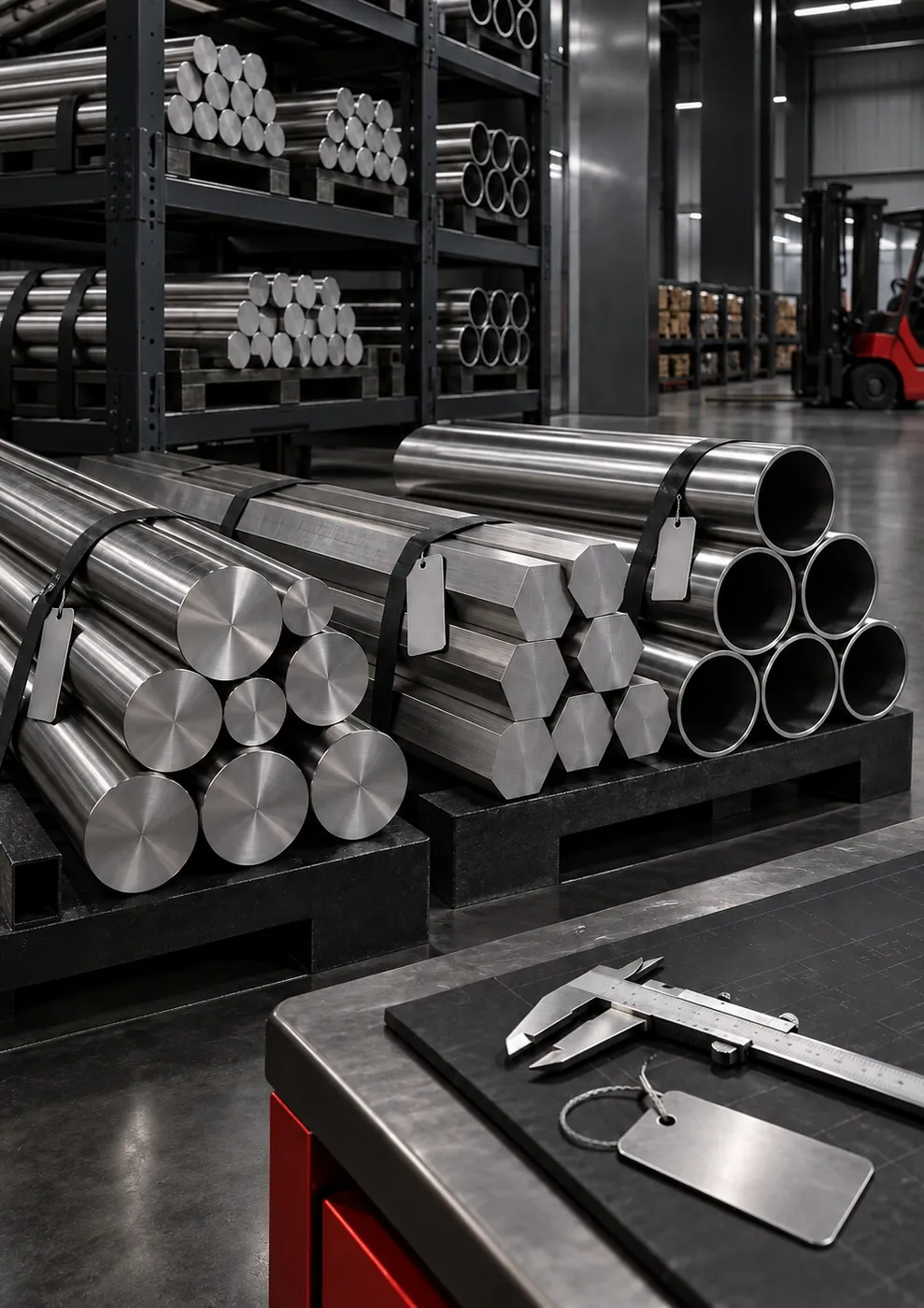
304 is the right choice for chloride-free, dry environments; 316 for chloride environments and threaded connections; and 316L for all of these plus welded joints. Titanium-stabilized 316Ti (1.4571) is preferred for parts that remain at sensitization temperatures for extended periods; if your specification calls for it, it should be stated in the request. GÜNEYSS uses AISI 316/316L round bar, hex bar and pipe as raw materials for its products and custom manufacturing; surface condition, diameter and batch information are checked at incoming raw material inspection. If you require a material certificate, please state this at the quote stage; the certificate that can be provided is clarified before the order is placed.