Shipyards & Ship Repair · Technical guide
What Affects Lead Time: Stock, Standard and Custom-Made Fittings
Quick answer
Stock items are prepared within an average of 1-3 business days, standard production within 5-10 business days, hose assemblies made to length within 5-15 business days, and custom-size and project parts within 10-20 business days after technical approval. Lead time is driven by raw material diameter, quantity, thread standard, and testing and surface requirements; sending complete information and photos with the first request cuts down the rounds of confirmation.
When a fitting will be delivered often determines when the line will run again. For a press down for maintenance, a ship waiting to leave port or a project with a fixed commissioning date, lead time matters as much as price. In this article we explain what determines lead time and what can be done at the inquiry stage to shorten it.
Basic scenarios
| Request type | Average time | When does the clock start? |
|---|---|---|
| Stock item | Ready to ship within 1-3 business days | Once the product and size are confirmed |
| Standard production | 5-10 business days | Upon order and size confirmation |
| Hose assembly (made to length) | 5-15 business days | Once the hose type, ends and length are confirmed |
| Custom-size and project manufacturing | 10-20 business days | After technical approval |
Times are given in business days and represent averages. The firm lead time is confirmed in writing at the quotation stage, based on the product, quantity and current production schedule.
A part's journey through production
In standard and custom manufacturing alike, every part goes through the same main steps. The duration of each step varies from part to part:
| Step | Scope | Average time |
|---|---|---|
| Raw material | AISI 316/316L verification | 0.5-1 day |
| Cutting | Preparation to diameter and length | 0.5-1 day |
| CNC machining | Threads, cones and surfaces | 2-5 days |
| Cleaning | Deburring and surface finishing | 0.5-1 day |
| Inspection | Dimensions, threads and sealing | 1-2 days |
| Packaging | Labeling and shipping | 0.5-1 day |
Six factors that determine lead time
1. Stock availability
Products held in stock in standard sizes are prepared for shipment shortly after inspection and packaging. Products that are not in stock, or of which only part of the required quantity is in stock, are added to the production schedule. Since stock levels can change during the day, lead times for stock items are confirmed based on availability at the time of order.
2. Raw material diameter
Every part is machined from round bar, hex bar or tube of a specific diameter. For parts that require a large hex, heavy-wall tube or an unusual diameter, raw material procurement may add to the lead time. Raw material availability is checked at the quotation stage.
3. Quantity
On small-batch custom jobs, machine setup (fixturing, tool selection, programming) accounts for a significant share of the total time. At high quantities, CNC machining time becomes the deciding factor. Once the quantity is finalized, production is planned around an appropriate batch size.
4. Thread standard
Common BSP, NPT, UNF/JIC and metric threads are machined routinely. Less frequently used thread types or special pitches may require additional tooling and inspection gauges. Since thread fit is verified with gauges at the inspection stage, sourcing a gauge for a thread that does not yet have one also becomes part of the planning.
5. Custom size and technical approval
In custom manufacturing, the lead time starts once the thread standard, sealing type and critical dimensions have been confirmed in writing. A delayed approval, or a dimensional change made after approval, shifts the schedule directly.
6. Testing and surface requirements
Order-specific sealing or pressure verification, special cleaning, marking or documentation requests can extend the inspection stage. When these requirements are specified at the quotation stage, they are built into the schedule from the start; when they are added later, the lead time grows.
How does a complete request shorten lead time?
Much of the time between quote and order is spent filling in missing information. Including the following in your first message reduces technical verification to a single step:
- Product type: fitting, adapter, hose assembly, flange, valve or custom part
- Thread standard, size and sealing type (if unknown, a photo taken with a caliper)
- Material: AISI 316 or 316L
- Quantity and, if needed, a requirement for partial deliveries
- Working pressure, temperature and fluid
- Technical drawing or sample for custom parts
- Any testing, marking or documentation requirements
- Required delivery date and delivery address
For example, when a WhatsApp message such as "G 1/2 male – 3/4-16 UNF (JIC) male straight adapter, AISI 316L, 40 pcs, hydraulic oil line; photos of both ends attached" also includes the working pressure and the required delivery date, we can move straight on to pricing and lead time without any follow-up questions.
When sending photos, one shot showing the whole part, a close-up of the thread area with a caliper, and, if there is one, a shot in which the marking on the part is legible are usually enough. If the part is connected to a piece of equipment, a photo of the port it connects to also makes it easier to identify the thread and sealing type.
Urgent and recurring needs
In urgent situations
For urgent maintenance needs, the first step is to look for a solution among standard products in stock. A part with no direct equivalent in stock can sometimes be covered temporarily by a suitable combination of standard adapters from stock; since every additional connection point means another potential leak, this solution should be kept temporary and the permanent part produced through scheduled manufacturing. State the urgency and the line downtime in your request; scheduling is assessed accordingly.
Cutting lead time up front for recurring needs
Plants with fixed maintenance schedules, shipyards and machine builders running series production need the same parts on a regular basis. In that case, instead of defining every order from scratch:
- Build a reference list of frequently used parts, with their thread standard, size and material.
- Keep approved technical drawings of custom parts on file with their revision numbers; specifying the same revision on a repeat order shortens technical verification.
- Share planned shutdown and maintenance periods in advance, so that your requirements can be factored into the production schedule early.
- For hose assemblies: the overall length, the type of both ends and, on elbow ends, the phase angle
Packaging and shipping
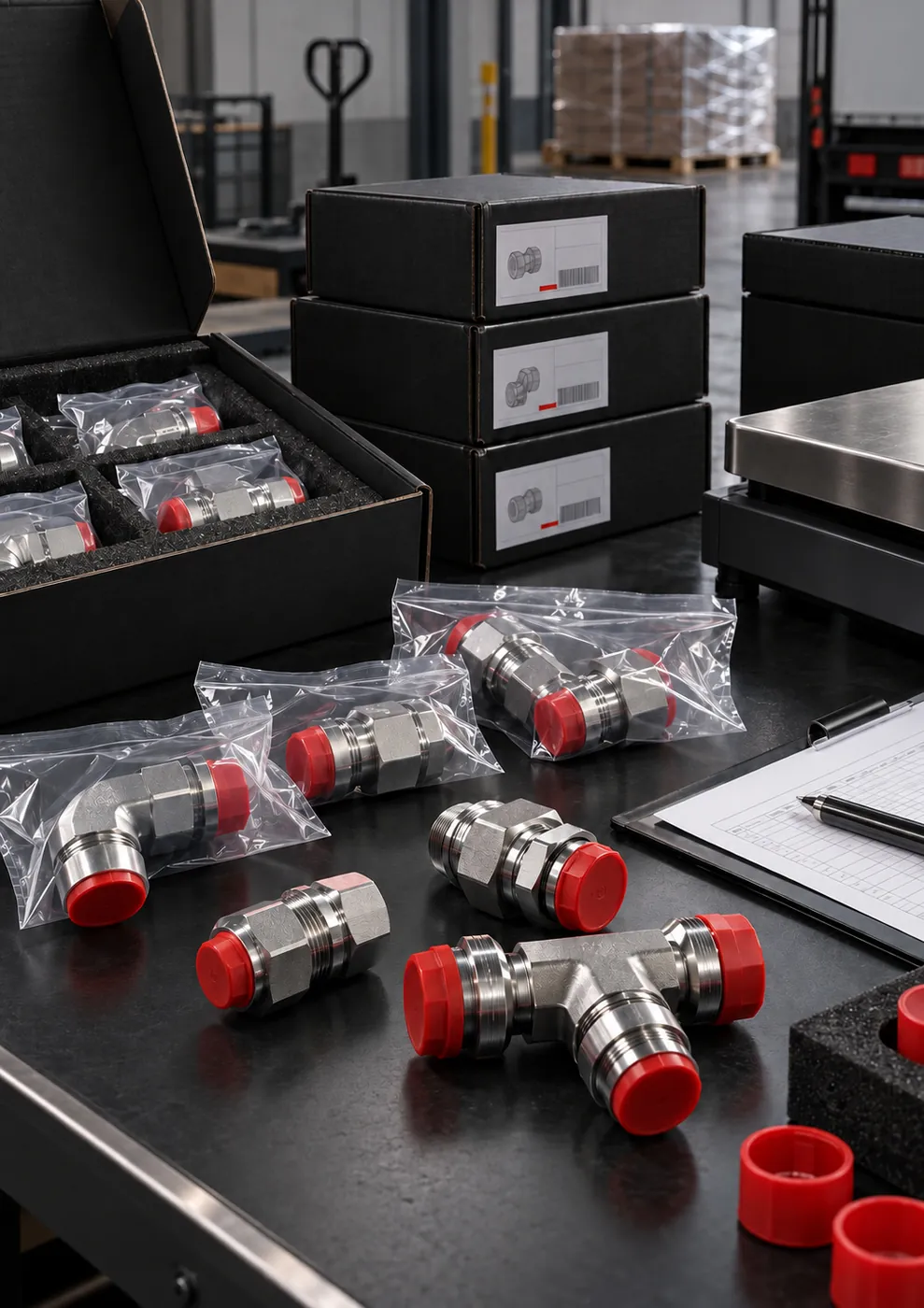
Once production is complete, thread and port openings are closed off with protective caps, and products are packaged separately by size and order batch. Before shipping, the quantity and product type are checked and a final visual inspection is carried out. This arrangement means parts can be put straight to use in the field on receipt, without any mix-ups. The shipping method and delivery address are finalized at the order stage; if partial shipments are needed, stating this from the outset makes planning easier.
Summary
- Stock items average 1-3 business days, standard production 5-10 business days, hose assemblies made to length 5-15 business days, and custom sizes 10-20 business days after technical approval.
- Raw material diameter, quantity, thread standard, and testing and surface requirements all affect lead time.
- In custom manufacturing, the lead time starts with technical approval; changes made after approval shift the schedule.
- Complete information and photos in the first message eliminate rounds of confirmation.